Which Investment Account Should You Open for Your Child?
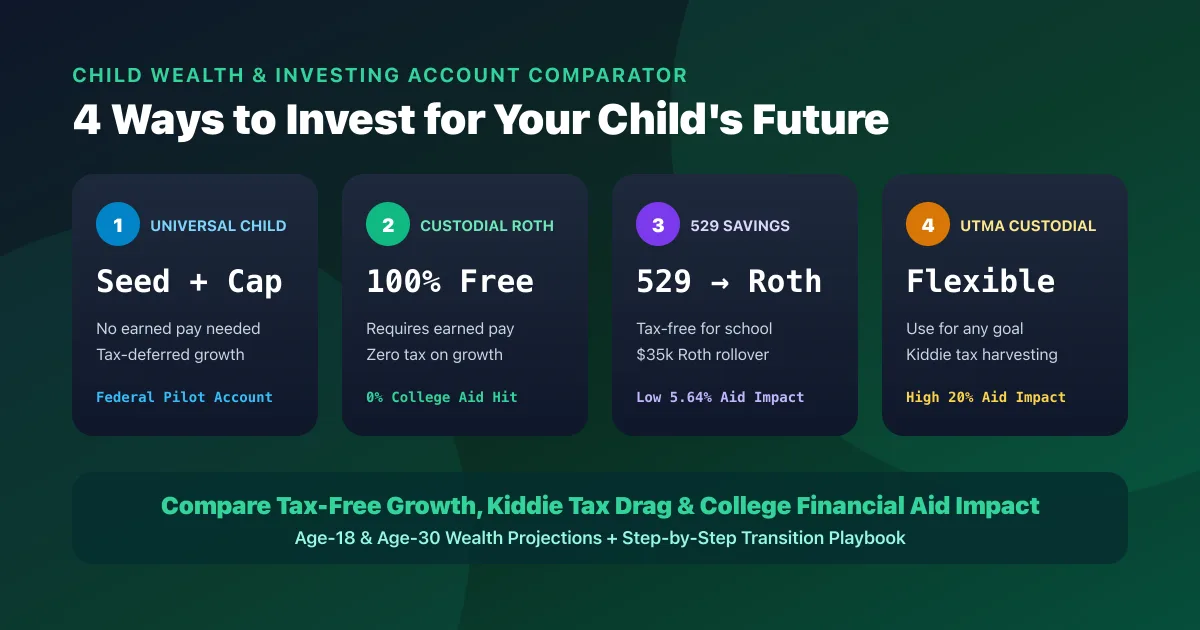
For most families, a 529 College Savings Plan paired with a Trump Account / Universal Child Account (or Custodial Brokerage account) is the best starting combination before your child has a job. If your child earns money from a summer job, babysitting, or family business work, a Custodial Roth IRA (capped at $7,500 per year in 2026) is unbeatable because contributions and investment gains grow 100% tax-free for life and are completely ignored by college financial aid formulas. For babies and young children without earned income, a 529 plan covers education tax-free with a built-in $35,000 Roth IRA rollover escape hatch, while a Trump Account (Universal Child Account under IRC Section 530A) (up to $5,000/year plus a $1,000 newborn seed) or UTMA Custodial Brokerage builds flexible wealth for a first home, business, or early retirement.
The 4 Child Investment Accounts Explained in Plain English
When you want to buy index funds like the S&P 500 or a Total Stock Market fund for a child under age 18, a minor cannot legally open a brokerage account on their own. Instead, an adult has to open an account with the child named as the beneficiary or legal owner.
Today, parents have four primary account wrappers to choose from. Each wrapper has its own rules for who can contribute, how investment gains are taxed, how college financial aid offices view the balance, and what happens on your child's 18th birthday:
- Trump Accounts (Universal Child Accounts / IRC Section 530A): Known widely in news headlines and public policy as Trump Accounts, these accounts are established under Internal Revenue Code Section 530A as a federal pilot investment account for American children. Created to give every child a head start on long-term stock market compounding, these tax-advantaged child accounts provide an automatic $1,000 federal newborn seed deposit for eligible babies born during the pilot window. Parents, grandparents, and employers can contribute up to $5,000 per year in after-tax funds until the child turns 18. Unlike a Custodial Roth IRA, your child does not need earned income from a job to receive contributions. The money is invested in low-cost broad U.S. stock index funds and compounds tax-deferred until adulthood.
- Custodial Roth IRA (Roth IRA for Kids): A retirement account managed by a parent on behalf of a minor who has legitimate earned income from work (such as a summer lifeguard job, W-2 teen employment, or age-appropriate work in a family business). In 2026, you can contribute up to $7,500 per year (or 100% of your child's earned pay, whichever is less). Even better, your child can keep their paycheck for spending money while you fund the Roth IRA with a dollar-for-dollar "parental match." Inside the account, all dividends and stock market gains are 100% tax-free forever.
- 529 College Savings Plan: An education-focused investment account owned by the parent with the child named as the beneficiary. Your investments grow 100% tax-free and can be withdrawn tax-free for college tuition, room and board, trade schools, laptops, and up to $10,000 per year in K-12 tuition. Many states also give you an immediate state income tax deduction or credit when you contribute. And if your child gets a scholarship or skips college, you can now roll up to $35,000 of leftover 529 money directly into your child's Roth IRA tax-free (see our 529-to-Roth IRA Rollover Calculator & Guide).
- Custodial Brokerage Account (UTMA / UGMA): A flexible, general-purpose taxable investment account opened under your state's Uniform Transfers to Minors Act (UTMA) or Uniform Gifts to Minors Act (UGMA). There is no earned income requirement, no annual contribution ceiling (you can gift up to $19,000 per parent or $38,000 per married couple in 2026 without filing a gift tax return), and zero restrictions on how the money is spent once your child reaches adulthood.
Side-by-Side Comparison: Trump Account (Universal Child Account) vs. Custodial Roth vs. 529 vs. UTMA
Use this comparison table to see how all four accounts stack up across contribution limits, tax treatment, college aid formulas, and age-18 control:
| Feature / Rule | Trump Account (Universal Child / § 530A) | Custodial Roth IRA | 529 Savings Plan | UTMA / UGMA Brokerage |
|---|---|---|---|---|
| Does Child Need Earned Income? | No. Open from birth with a Social Security Number. | Yes. Must have taxable earned pay from work. | No. Open from birth for any child. | No. Open from birth for any child. |
| 2026 Annual Contribution Limit | $5,000/year (plus $1,000 federal seed for eligible newborns). | $7,500/year (capped at child's annual earned pay). | No annual limit ($19,000 single / $38,000 couple gift exclusion; $190,000 5-yr superfunding). | No annual limit ($19,000 single / $38,000 couple annual gift tax exclusion). |
| How Investment Growth Is Taxed | Grows tax-deferred; gains taxed at long-term capital gains or retirement rates when used. | 100% Tax-Free growth and tax-free retirement withdrawals. | 100% Tax-Free for qualified school costs or up to $35,000 Roth IRA rollover. | First $1,350/yr of unearned gains is 0% tax; next $1,350 is 10%; above $2,700 taxed at parent's rate. |
| College Financial Aid Impact (FAFSA) | Assessed as a student asset unless converted into a retirement wrapper. | 0% Impact. Retirement balances are excluded from FAFSA asset formulas. | Minimal (Max 5.64%). Counted as a parent asset, not a student asset. | Heavy (20% Rate). Counted directly as the student's personal asset. |
| Can You Change the Beneficiary? | No. Belongs permanently to the named child. | No. Belongs permanently to the named child. | Yes. Parents can switch the beneficiary to a sibling or family member anytime. | No. Gifts into a UTMA are irrevocable and belong to the child. |
| What Happens at Age 18 / 21? | Transitions to adult control for a first home, education, business, or retirement rollover. | Converts to a standard adult Roth IRA; contributions can be withdrawn tax-free anytime. | Parent keeps control for life, even after the child turns 18 or 21. | Child gains 100% legal control of the money at age 18 to 21 (depending on state). |
How Kiddie Tax Rules Work for Kids' Investments (And How to Pay $0 Tax)
Many parents hesitate to open a regular Custodial Brokerage account (UTMA/UGMA) because they hear about the "Kiddie Tax." In reality, according to IRS guidelines on investment income for children, the Kiddie Tax actually gives your child a generous annual tax-free allowance on dividends and realized capital gains:
- The First $1,350 of Investment Gains Every Year Is Taxed at 0%: As long as your child's unearned income (dividends, interest, and realized stock gains) stays at or below $1,350 in 2026, they owe $0 in federal tax and you don't even have to file a tax return for them.
- The Next $1,350 (Up to $2,700) Is Taxed at Your Child's 10% Rate: Investment income between $1,350 and $2,700 is taxed at the child's own 10% bracket, meaning that entire slice costs at most $135 in federal tax.
- Above $2,700 Is Taxed at the Parents' Rate: Only unearned income above $2,700 per year gets taxed at your higher parental tax bracket.
Tax-Gain Harvesting Trick for UTMA Accounts
How Financial Aid Treats Money in a Parent's Name vs. a Child's Name
If your family might qualify for need-based college financial aid, or even certain merit-and-need hybrid grants, the account type you choose can swing your financial aid package by tens of thousands of dollars. Under federal college aid handbooks, the Student Aid Index (SAI) formula assesses assets in three distinct buckets:
- Bucket 1: Retirement Accounts (0% Financial Aid Impact): Balances inside a Custodial Roth IRA (as well as parents' 401(k)s and IRAs) are completely sheltered from the FAFSA asset test. Just keep in mind that if your child withdraws money from their Roth IRA during college, that withdrawal can count as untaxed student income on a future aid application, so it is best to leave the Custodial Roth untouched until after graduation.
- Bucket 2: Parent-Owned 529 Plans (Maximum 5.64% Impact): Even though your child is the beneficiary, a 529 plan is legally treated as a parental asset on financial aid forms. That means $50,000 in a 529 plan reduces need-based aid eligibility by at most $2,820 per year. Better yet, tax-free 529 withdrawals used to pay for college do not count as student income on the following year's FAFSA.
- Bucket 3: Student-Owned UTMA / Custodial Accounts (Flat 20% Impact): Any money held in a UTMA/UGMA custodial brokerage account (or non-retirement Universal Child Account balance) is legally the student's property. Aid formulas assess student assets at a flat 20% rate every year. That same $50,000 sitting in a UTMA reduces financial aid eligibility by $10,000 per year, or up to $40,000 over a four-year degree. (Tip: Prior to filing the FAFSA, parents can legally liquidate a UTMA and transfer the proceeds into a Custodial 529 Plan, which immediately drops the financial aid assessment rate from 20% down to the parental 5.64% rate).
What Happens When Your Child Turns 18? (Basis, Taxes & Roth Rollovers)
One of the biggest misconceptions parents have is worrying that their child will face a huge tax bill the day they turn 18, or that original deposits will get taxed twice. Here is exactly what happens when your child reaches adulthood (age 18 or 21 depending on your state) and how to transition their accounts with minimal or zero taxes:
- Your Original Deposits Stay Yours (and Your Child's) 100% Tax-Free: Every dollar you deposited into a Custodial Roth IRA, 529 plan, Universal Child Account, or UTMA brokerage was funded with after-tax money. Your original contributions (called your cost basis) are never taxed again when withdrawn or transferred. Only the net investment profits above your original contributions are ever subject to tax rules.
- The Age 18–22 "Zero-Tax Window" for Young Adults: Between ages 18 and 22, when your child is in college, trade school, or working entry-level jobs, they are no longer minor children and once they support themselves or finish school, they file as independent single adults. Because single filers enjoy a generous standard deduction plus a 0% long-term capital gains tax bracket on taxable income up to ~$48,000+, a young adult earning a modest paycheck can sell appreciated UTMA index funds or convert Universal Child Account balances while paying 0% to 10% in federal tax.
- Rolling Child Account Funds Into an Adult Roth IRA: Once your child is 18+ and earning paychecks from a part-time job, internship, or first career role, they can systematically shift their childhood savings into a lifelong tax-free Roth IRA:
- From a 529 Plan: If the 529 account has been open for at least 15 years, you can execute a direct plan-to-custodian transfer of up to $7,500 per year (up to the $35,000 lifetime cap) straight into their Roth IRA with zero tax and zero penalty. Model your exact timeline in our 529-to-Roth IRA Rollover Calculator.
- From a Universal Child Account or UTMA Brokerage: Each year that your young adult earns at least $7,500 at a job, they can transfer or withdraw $7,500 from their childhood account and contribute it directly into their Roth IRA, effectively moving their childhood portfolio into a permanently tax-free wrapper over 3 to 5 years.
The Optimal Step-by-Step Child Wealth Waterfall for Parents
Before locking up money in a child's name, make sure your own household foundation is secure. Use our Debt Avalanche vs. Investing Calculator to eliminate high-interest debt, and check our Mega Backdoor Roth Calculator and Core Principles of Financial Independence (FI/RE) Curriculum so you never sacrifice your own retirement security.
Once your own retirement is on track, follow this four-step priority order for your child, backed by historical market return data on multi-decade compounding:
- Step 1 (Birth to Age 5): Open an individual 529 College Savings Plan in your child's name as soon as they receive a Social Security Number to start their 15-year Roth rollover clock, and claim the Universal Child Account newborn seed if eligible.
- Step 2 (Ages 6 to 13): Automate monthly contributions into your state's 529 plan up to your state tax deduction ceiling. If you want additional unrestricted funds for your child's first car, wedding, or house down payment, direct extra savings into a Universal Child Account or UTMA Custodial Brokerage and harvest up to $1,350/year in tax-free gains.
- Step 3 (Ages 14 to 17, First Summer Jobs): The moment your teenager earns W-2 wages from a summer job, lifeguarding, tutoring, or working in your business, open a Custodial Roth IRA and match 100% of their earnings up to $7,500/year.
- Step 4 (Ages 18 to 25, Young Adult Transition): Convert any remaining 529 leftovers via the $35,000 Roth IRA rollover rule and gradually shift UTMA or Universal Child Account funds into their adult Roth IRA and workplace 401(k).
 Buck by Buck
Discussion 0
Questions, thoughts, or experience to share on Universal Child Accounts vs. Custodial Roth vs. 529 vs. UTMA? Join the conversation below.