🌱 Financial Literacy & Generational Wealth
The Complete Kids Money Milestones Timeline
What to teach, how to practice, and which accounts to open at each stage of your child’s development, from tangible preschool coins to post-18 financial independence.
📅 Ages 3 through 18+
• 🧭 5 Milestone Phases
• 📥 Printable Roadmap Included
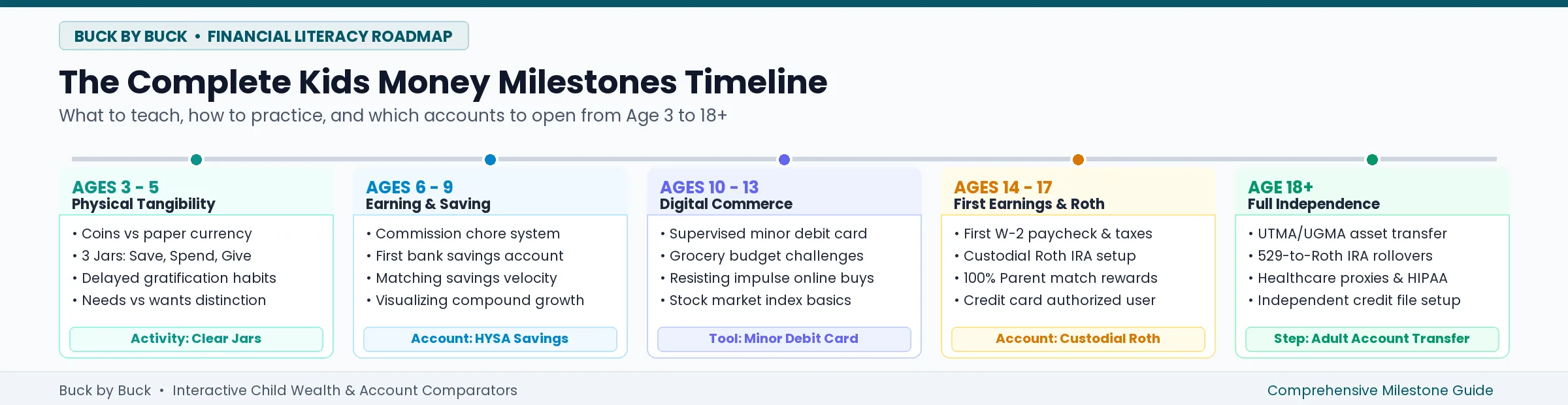
💡 Visual Roadmap: Use the age phase jumper to jump directly to milestone exercises, account setups, and parent scripts across each age band.
Download PDF Version →
Jump to Age Phase:
Why Modern Kids Struggle with Money (The Invisible Cash Problem)
For generations, money was tangible. Children watched parents hand dollar bills to the cashier and receive physical change. Today, money is completely invisible: a card tap on a screen, a phone hover, or a click on an app. To a young child, plastic cards appear to be magic rectangles that produce infinite goods without consequence.
Raising financially confident children requires systematically peeling back this invisibility. By introducing concrete physical lessons early, then gradually layering on banking, budgeting, earning, and investing, you transform money from an abstract stressor into a practical life tool.
Phase 1 • Preschool to Kindergarten
Ages 3 to 5: Physical Tangibility & Scarcity
Focus: Seeing Money Disappear
🎯 Core Concept to Master
Money is finite. When you spend a coin or dollar bill on a toy or treat, that exact money is gone and cannot be spent on something else.
🏦 Recommended Account Setup
No bank accounts yet. Use 3 clear mason jars labeled: Spend, Save, and Give. Clear jars let kids watch their stacks physically grow or shrink.
Milestone Exercises & Action Steps:
- ✔ The Store Cashier Hand-Off: Give your child physical coins or a $1 bill at the grocery store or farmers market. Let them physically hand the money to the cashier and experience the sensation of letting it go in exchange for an apple or sticker.
- ✔ Delayed Gratification Grocery Game: When your child asks for a toy in the checkout aisle, avoid saying "we do not have money for that." Instead, say: "That toy is not on our shopping list today. Let us take a photo of it, and if you still want it for your birthday, we will put it on your list."
- ✔ Coin Sorting & Recognition: Turn identification of pennies, nickels, dimes, and quarters into a matching game. Explain that four quarters equal one paper dollar.
Phase 2 • Elementary School
Ages 6 to 9: Earning, Budgeting & The Power of Saving
Focus: Labor to Income Connection
🎯 Core Concept to Master
Money comes from solving problems and completing work, not entitlements. Saving today unlocks larger rewards tomorrow through compound growth.
🏦 Recommended Account Setup
Open a joint or custodial HYSA or visit a local credit union branch. Bring your child to the counter to sign their signature card.
Milestone Exercises & Action Steps:
- ✔ The "Citizenship vs. Commission" Chore System: Routine chores (cleaning their bedroom, setting their plate) are unpaid family contributions. Offer a list of optional commission tasks with set dollar values (washing windows for $3, raking autumn leaves for $5).
- ✔ The Bank of Mom & Dad 100% Match: To demonstrate compound interest visually, offer a 50% or 100% parental match on any money kept in their savings jar for at least three months. Watching $10 turn into $20 makes saving exciting.
- ✔ Price Comparison at the Supermarket: Involve your child in grocery shopping. Ask them to compare price tags on two cereal boxes or snack brands and calculate which option saves money.
Phase 3 • Middle School
Ages 10 to 13: Digital Money & Smart Consumerism
Focus: Navigating Modern Electronic Commerce
🎯 Core Concept to Master
Advertising and mobile apps are engineered to encourage mindless spending. Understanding opportunity cost and tracking digital card swipes prevents lifestyle inflation.
🏦 Recommended Account Setup
Supervised minor debit cards (like Greenlight, Chase First Banking, or Fidelity Youth Account). Lets parents set spending categories and automate monthly transfers.
Milestone Exercises & Action Steps:
- ✔ The 48-Hour Waiting Rule: For any non-essential purchase exceeding $30, institute a mandatory 48-hour pause. If they still want the item two days later and have the cash saved, they can purchase it. More than half the time, the impulse fades.
- ✔ Introduction to Stock Ownership: Teach the difference between being a consumer and being an owner. If your child loves Nike shoes, Nintendo games, or Apple iPads, show them how buying shares of an index fund lets them own a tiny slice of all those companies.
- ✔ Clothing & School Supplies Budget: Give your child a fixed seasonal budget (e.g., $150) for back-to-school clothes. If they buy one $100 designer hoodie, they must budget the remaining $50 across everything else. Experiencing trade-offs early builds natural self-restraint.
Phase 4 • High School
Ages 14 to 17: First Paychecks, Taxes & Investing
Focus: Real World Taxes & Building Credit
🎯 Core Concept to Master
Gross pay does not equal take-home pay. Compounding invested dollars in a Roth IRA during teenage years creates massive wealth because of a 50-year time horizon.
🏦 Recommended Account Setup
Open a Custodial Roth IRA (at Fidelity or Charles Schwab) and add your teen as an Authorized User on a primary parent credit card with a spotless payment history.
Milestone Exercises & Action Steps:
- ✔ Deconstructing the First Paystub: Walk through their first paycheck. Explain why gross earnings of $400 only yielded $340 in their account. Demystify Social Security, Medicare, and state tax withholdings so taxes do not shock them later.
- ✔ The Parental Roth IRA Match: If your teen earns $3,000 working summer lifeguard or babysitting jobs, do not force them to lock away their spending cash. Instead, offer to deposit $3,000 of family funds directly into their Custodial Roth IRA as a match. Compounding $3,000 for 50 years at 8% average return yields over $140,000 in completely tax-free wealth.
- ✔ Building Credit File History: Add them as an authorized user around age 16. Explain that credit cards are not free money or emergency loans; they are payment methods that must be paid in full every single month to avoid predatory interest.
Phase 5 • Young Adulthood
Age 18+: Full Legal Independence & The Handover
Focus: Asset Handover & Legal Rights
🎯 Core Concept to Master
At age 18, your child becomes a legal adult. Parents no longer have automatic access to bank balances, medical records, or academic grades. Financial literacy now means independent execution.
🏦 Recommended Account Setup
Transition custodial accounts into individual adult accounts. Establish basic legal documents (Healthcare Proxy, HIPAA release, and Financial Power of Attorney).
Milestone Exercises & Action Steps:
- ✔ UTMA/UGMA Custodial Account Retitling: Complete the custodian transfer paperwork at the brokerage so the account converts to an individual taxable account under their name alone.
- ✔ 529-to-Roth Rollover Planning: If your family has leftover funds in a 529 college savings plan, walk your young adult through rolling up to $35,000 of unused funds over their lifetime into their own personal Roth IRA using our 529-to-Roth Rollover Rules Guide.
- ✔ Sign Healthcare & Financial Proxies: If your 19-year-old child suffers a medical emergency at college, doctors legally cannot share information with parents without a signed HIPAA release and Healthcare Power of Attorney. Have them execute these basic documents before moving away.
Summary Cheat Sheet: Accounts to Open by Age
| Age Bracket | Primary Vehicle | Key Financial Lesson | Parent Action |
|---|---|---|---|
| Ages 3 to 5 | 3 Clear Jars (Spend, Save, Give) | Money is physical and finite | Hand physical coins to cashier |
| Ages 6 to 9 | High-Yield Savings Account | Labor creates income; savings compound | Commission chore list + match savings |
| Ages 10 to 13 | Supervised Minor Debit Card | Electronic budgeting & resisting impulses | Institute 48-hour pause rule |
| Ages 14 to 17 | Custodial Roth IRA + Authorized User | Taxes, investing, and establishing credit | Match teen W-2 earnings into Roth |
| Age 18+ | Adult Accounts & Legal Healthcare Proxy | Legal adulthood & independent execution | Hand over UTMA & execute HIPAA release |
📥 Free Printable PDF Checklist 1-Page Printable PDF
Download the Generational Wealth & Minor Account Setup Checklist (PDF)
Get our 1-page printable checklist comparing custodial brokerage, 529 college savings, and custodial Roth IRA setup steps.
- ✓ Custodial Roth IRA setup prerequisites and parent match rules
- ✓ 529 plan contribution limits and 5-year front-loading strategies
- ✓ UTMA vs 529 college aid (FAFSA) impact comparison table
✓
Your PDF is Ready!
Click below to download or save your printable companion guide:
We also sent a backup copy to your email. Keep this reference handy for future planning!
❓ Common Questions
Frequently Asked Questions: Teaching Kids About Money
Clear answers on allowances, custodial accounts, teen taxes, and financial handovers.
At what age should I start teaching my kids about money?
You can start teaching kids about money as early as age 3 or 4 by introducing tangible coins, paper cash, and the three-jar system for saving, spending, and giving. Children at this stage cannot grasp abstract digital balances, but they easily understand that handing physical coins to a store cashier means the coins are gone forever.
Should chores be tied to allowance for kids?
Chores should be split into unpaid household citizenship duties and paid commissions for extra tasks. Baseline responsibilities like making their bed or clearing their own dinner plate teach family contribution without cash rewards. Extra discretionary jobs like washing the family car, weeding the yard, or organizing the garage teach the real-world connection between effort and income.
When should I open a bank account or debit card for my child?
Open a high-yield savings account between ages 6 and 9 so your child can physically deposit birthday cash and watch interest accumulate on their statements. Transition to a supervised debit card between ages 10 and 13 to teach electronic budgeting, card security, and balance tracking before they leave for high school or get their first job.
Can my teenager open a Roth IRA before age 18?
Yes, a teenager of any age can fund a custodial Roth IRA as long as they have legitimate earned income reported on a W-2 or verified self-employment earnings. Parents can even 100% match their teen’s contributions up to their annual earned income limit, letting the teenager keep their hard-earned cash while funding decades of tax-free compound growth.
Should I make my teenager an authorized user on my credit card?
Adding a responsible teenager as an authorized user around age 15 or 16 helps them establish a clean credit history years before college. You do not even need to give them the physical card; your on-time payment history reports directly to their credit file, providing them with a strong credit score when renting their first apartment.
What happens to a custodial account (UTMA or UGMA) when my child turns 18 or 21?
Assets inside an irrevocable custodial account legally transfer entirely to the child once they reach the statutory age of majority in your state (typically age 18 or 21). The beneficiary gains full, unrestricted control over the funds, which is why parents aiming for education funding often prefer 529 plans or family living trusts.
Related Tools and Family Wealth Guides
Interactive Comparator
Child Wealth Accounts Compared →
Compare projected balances, tax drag, and financial aid impact across 529, UTMA, and Roth accounts.
Estate Planning GuideUltra-Rich Estate Strategies Demystified →
What billionaires do, what it costs, and what makes sense at each family net worth tier.
Education Planning529-to-Roth IRA Rollover Rules →
How to rollover up to $35,000 of leftover college funds into your child's Roth IRA penalty-free.
Asset ProtectionLiving Trust Funding Checklist →
Ensure family assets pass directly to your children without expensive probate delays.
Mobile Handoff
Scan to Open on Phone
Point your phone's camera at the QR code to seamlessly continue reading or calculate with your current inputs on mobile.
 Buck by Buck
No app required
🔖
Bookmark this page
Press ⌘+D or Ctrl+D to save to your browser bookmarks.
Discussion 0
Author replies within 24h