
Why Turning A Primary Residence Into A Rental Is A Bad Idea
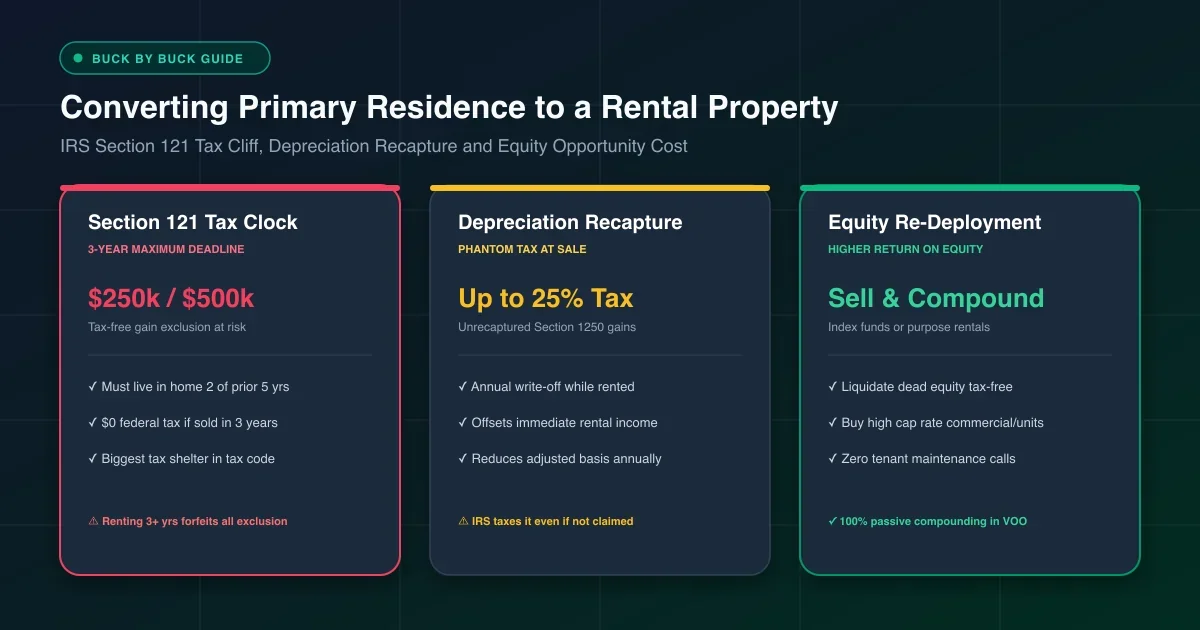
If you’re thinking about or already have turned a primary residence into a rental, you might want to rethink that. Even if your property is allegedly in a “high appreciation” market, it still may not make financial sense to hold on to it. To understand why, it all comes down to a numbers game, especially taxes. In this post, I will share why I decided to sell my very 1st primary residence instead of turning it into a rental, how I determined that was the best financial decision, and the numbers to back up my decision.
- 1. Mortgage Occupancy Covenant: Conventional primary loans typically require living in the home for at least 12 months before converting into a rental. Renting out immediately without lender permission violates loan covenants.
- 2. Landlord Insurance (DP-3): Standard homeowners policies (HO-3) will not cover tenant damage or liability. You must switch to a landlord policy before a tenant moves in.
- 3. IRS Section 121 Tax Clock: You can exclude up to $250,000 in capital gains ($500,000 married) only if you lived in the home for 2 of the previous 5 years. Once rented for over 3 years, this tax-free windfall vanishes.
- 4. Depreciation Recapture: The IRS taxes accumulated property depreciation upon sale at up to 25%, even if you forgot to claim it on your tax return.
Is it even legal to turn a primary home into a rental?
Before I dive into my home sale and all the numbers behind it, I first want to call out the legality behind turning a primary residence into a rental. If you purchased the home entirely with cash, then you have no loan. That means you can pretty much do what you want with the home (unless renting it out is forbidden by your HOA).
However, most people purchase a home with a loan. When you do that, the terms of your loan specifically state the intended use of the home. So if you tell the lender it’s going to be your primary residence (owner occupied), you can’t use the home as a rental immediately after purchasing it. If you do, that’s bank fraud and can result in jail time!
In most cases, people do live in it for a while and then consider turning it into a rental after several years. Is it legal to do this at that point? Well, the answer is that it depends. I strongly recommend you contact your lender to find out. You don’t want to wind up in a situation that’s potentially fraudulent.
To play it safe, I think turning a primary home into a rental can be done by simply refinancing your home and replacing your owner-occupied mortgage with an investment property mortgage. That way, the terms of your loan legally allow you to rent out the home.
Do the numbers even make sense?
Back in 2012, I purchased my 1st home for $390,000. In 2015, I sold my home for $650,000.
Fast forward to today, and now it’s worth about $800,000. So in the past 5 years, had I kept the home, it would’ve appreciated an additional $150K. Additionally, if I turned it into a rental, how much rental income would I have brought in over those 5 years? The answer comes out to roughly $6,000 per year plus principal pay down of my mortgage, totaling about $50K of additional cash to me (forget about taxes for simplicity’s sake).
The question I have to ask myself is, “Have I made more money from the proceeds of my home sale over the past 5 years, or would I have made more money by renting it out?” First, let’s talk about the sale of my home. Because I lived in my home for at least 2 years between 2012 and 2015, selling my home qualified for the home sale tax exclusion rule. The rule states that if you live in a home for 2 of the past 5 years, you do not have to pay capital gains taxes on the first $250,000 in profit ($500K if you’re married and you both own the home jointly!). So my $650K home sale, minus 6% in sales commissions, came out to $611,000. Subtracting my purchase price of $390K, my profit was $221,000. Therefore, using the home sale tax exclusion rule, I paid $0 in taxes and pocketed the entire profit!
Alright, so I had $221,000 in cash, plus about $100K in equity I had in the house. Therefore, I had $321K of cash to invest elsewhere. Assuming I invested that into the S&P 500 in 2015, that $321K would’ve turned into $675K, a $354K profit!
On the other hand, had I kept the home during the same 5-year timespan, I would’ve been able to sell at $800K and collected an additional $50K in profit plus principal paydown. Applying the same $250K home sale tax exclusion rule on an $800K home sale, my profit would’ve been $362K. Of that $362K, $250K of it is tax-free. That leaves $112K of the profit getting taxed at a max of 20% long-term capital gains. So my final proceeds would’ve been $339,600.
Here’s a summary of what all those numbers look like:
| Sell home in 2015 & invest proceeds in S&P 500 | Turn home into rental in 2015 & sell home in 2020 | |
|---|---|---|
| Purchase price (in 2012) | $390,000 | $390,000 |
| Home sale | $650,000 (in 2015) | $800,000 (in 2020) |
| Sales commission (6%) | ($39,000) | ($48,000) |
| Home sale tax exclusion | ($250,000) | ($250,000) |
| Home sale taxes | $0 | ($22,400) |
| Final home sale proceeds | $221,000 | $339,600 |
| Equity in home | ~$100,000 | ~$120,000 |
| Stock investments vs rental income | ~$354,000 | ~$30,000 |
| Final balance in 2020 | $675,000 | $489,600 |
Calculate Your Exact Property Numbers
Wondering what your home would actually cash flow after vacancy, property management, capex, and property taxes? Test your numbers before locking up your equity.
So instead of blindly assuming that turning a primary residence into a rental is always the right financial decision, I strongly urge you to run the numbers, factor in the home sale tax exclusion rule, and consider the full opportunity cost before deciding! I will admit that if your home has a reasonable profit margin as a rental, it’s probably not a bad choice, but is it the best? Well, that’s highly dependent on your unique property and how the numbers play out!
Planning to Sell or Rent Your Home?
Get our free Primary vs. Rental Opportunity Cost cheat sheet with IRS Section 121 timelines, depreciation recapture traps, and stock market comparison formulas.
Zero spam. Unsubscribe with one click anytime.
Converting a Primary Home to a Rental: Frequently Asked Questions
Can you legally rent out your primary residence?
Yes, you can legally rent out a primary residence, provided you comply with loan occupancy agreements. Most conventional mortgages require owner occupancy for at least 12 months after purchase before converting into an investment property. Always verify with your lender and HOA bylaws first.
How do you convert a primary residence to an investment property?
To convert your primary home into a rental, complete four essential steps: verify you have satisfied the 12-month owner-occupancy mortgage covenant, switch homeowners insurance to a landlord DP-3 hazard policy, establish property depreciation based on the lower of fair market value or adjusted cost basis, and maintain separate rental operating bank accounts.
How does the Section 121 tax exclusion work when renting out your home?
Under IRS Section 121, you can exclude up to $250,000 in capital gains ($500,000 for married couples filing jointly) if you lived in the home as your primary residence for at least 2 of the previous 5 years before the sale date. If you rent out the home for more than 3 years, you forfeit this tax-free windfall completely.
Before holding onto residential real estate, evaluate alternative wealth-building vehicles. Review our analysis of why stock market investing builds enduring wealth or test your numbers with our free Real Estate Evaluation Tool.
Scan to Open on Phone
Point your phone's camera at the QR code to seamlessly continue reading or calculate with your current inputs on mobile.
 Buck by Buck
No app required
Buck by Buck
No app required Bookmark this page
Press ⌘+D or Ctrl+D to save to your browser bookmarks.
Trending & Popular Guides
How to Set Up a Mega Backdoor Roth With Fidelity
How to Set Up a Backdoor Roth IRA With Fidelity
How to Set Up Automatic Investing with Fidelity
How to Set Up Automatic Investing with E*TRADE
Related Articles & Guides
View all guides
What's A Better Investment: Primary Residence or Stocks?
Normally, a primary residence should not be considered an investment unless you house hack and rent out part of the home while you live in it or you end up selling the home. In the
6 Reasons Why I Invest In Real Estate to Build Wealth
I know plenty of successful investors who invest entirely in the stock market and in no other asset classes, like real estate. On the other hand, I also know many successful invest

With $8,200,000 In Debt, When Will I Be Debt Free?
In my previous post where I shared my $10 million FI/RE goal by age 40, I mentioned that my investment allocation will be 30% in real estate. That’s $3M of my own cash invested in r
Discussion 0
Questions, thoughts, or experience to share on Why Turning A Primary Residence Into A Rental Is A Bad Idea? Join the conversation below.