Listen to Full Article
ReadyFull article audio (6 min) • Click to listen from start to finish
Read Selection (0 words)
"..."
Ch: How to Convert Your Primary Residence Into a Rental Property
Rental Property Evaluation & Underwriting Playbook
A 1-page underwriting cheat sheet with Cap Rate, Cash-on-Cash Return, reserve sizing, and 50% expense benchmarks.
- ✓ Cap Rate, Cash-on-Cash & Return on Equity (ROE) math
- ✓ 6-month PITI & CapEx reserve sizing guidelines
- ✓ DP-3 landlord insurance & tax exclusion timeline
Your PDF is Ready!
Click below to download or save your printable companion guide:
We also sent a backup copy to your email. Keep this reference handy for future planning!
1. Verify Your 12-Month Mortgage Occupancy Covenant
Almost every conventional, FHA, and VA primary-residence loan includes an owner-occupancy clause requiring you to live in the property as your primary home for 12 consecutive months from closing.
- Passed 12+ months? You are free to convert it to a rental and keep your existing low-rate mortgage without refinancing.
- Moving before 12 months? Contact your servicer for written approval (typically granted for employer relocation >50 miles or documented family changes) so the move is never flagged as occupancy fraud.
2. Switch From HO-3 Homeowners to DP-3 Landlord Coverage
Do not skip this step: an ordinary HO-3 Homeowners Policy Standard insurance for owner-occupied homes. It excludes tenant liability and vacancy/rental exposure once you stop living there full-time. can void claims after you move out. Before handing keys to a tenant:
- Bind a DP-3 Landlord Policy covering dwelling structure, loss-of-rent coverage (if a fire makes the unit uninhabitable), and landlord premises liability.
- Require your tenants in the lease to maintain active renters insurance ($100k+ personal liability) listing you as an interested party.
- Add a $1M+ personal umbrella policy over the rental for catastrophic liability protection.
3. Mark Your 3-Year Tax-Free Sale Exclusion Deadline
Under the IRS 2-of-5-Year Home Sale Exclusion IRS Section 121 allows homeowners to exclude up to $250,000 ($500,000 if married filing jointly) of capital gains tax-free when selling a primary residence lived in for at least 2 of the past 5 years. , your move-out date starts an irreversible clock. If you lived in the house for at least 2 years, you generally retain your $250k / $500k tax-free gain exclusion only if you sell within ~3 years of moving out.
Should you actually hold it at all? Read our breakdown on Why Turning a Primary Residence Into a Rental Is Often a Bad Idea to compare the tax cost against selling tax-free and redeploying the equity.
4. Establish Depreciation Basis & Drop Your Homestead Exemption
- Revoke Homestead Tax Exemption: Notify your county tax assessor when you convert the property so you do not accrue back-tax penalties and interest for claiming an owner-occupied property tax break illegally.
- Set Your Schedule E Cost Basis: Take a dated Zillow/CMA snapshot or formal valuation on your placed-in-service date. Residential rentals depreciate over 27.5 years on the lower of adjusted cost basis or fair market value (excluding land value). Note that claimed depreciation is later subject to Depreciation Recapture When selling a rental property, previously claimed (or allowable) depreciation is taxed up to 25% unless deferred via a 1031 exchange. upon sale.
5. Stress-Test True Cash Flow & Return on Equity
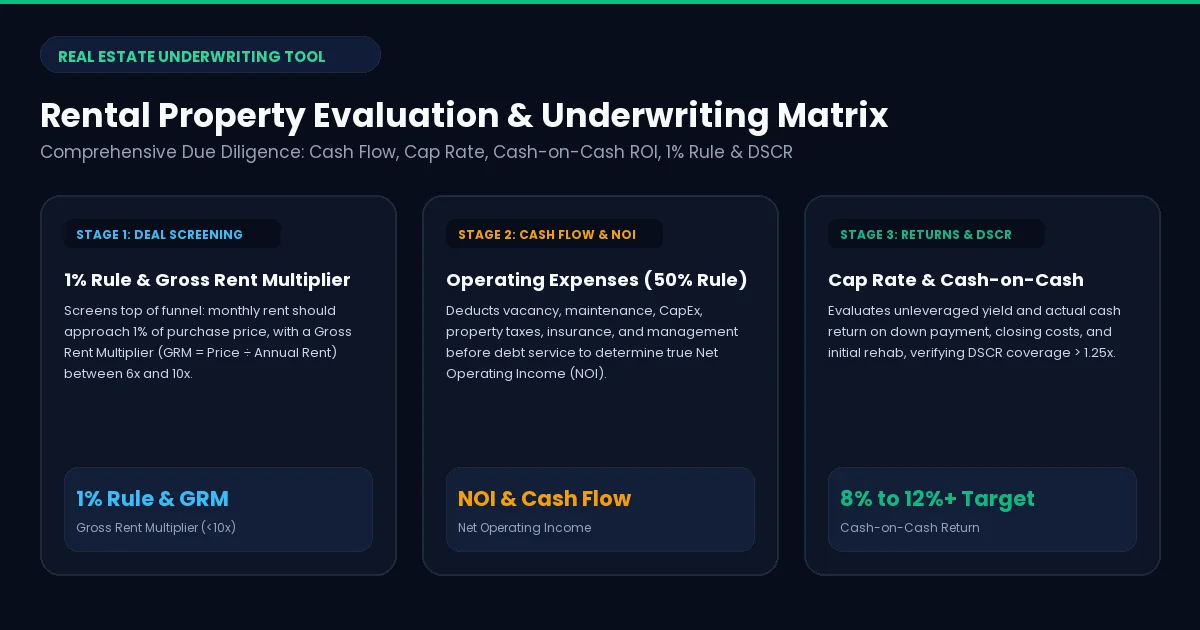
Never look solely at monthly rent minus mortgage payment. Factor in property management (8% to 10%), vacancy (5% to 8%), maintenance/CapEx reserves (10% to 15%), higher non-homestead property taxes, and return on your trapped equity using our Real Estate Evaluation Tool.
Frequently Asked Questions
Quick answers to common questions, technical edge cases, and tax rules.
Is it legal to turn my primary residence into a rental property?
Yes, once you satisfy your mortgage's owner-occupancy requirement—typically living in the property as your primary residence for at least 12 consecutive months after closing. If an unexpected job relocation or family hardship forces a move earlier, lenders routinely grant written exceptions upon request.
Do I have to tell my mortgage lender when turning my house into a rental?
If you have lived in the home for 12+ months, conventional and FHA loans generally do not require refinancing into an investment loan, and your low primary-residence interest rate stays intact. However, you must update your mailing address and switch your homeowners insurance to a DP-3 landlord policy, which notifies your loan servicer's escrow team.
What happens to my $250k / $500k home sale tax exclusion when I rent out my home?
You keep the primary residence capital gains exclusion ($250k single / $500k married) only as long as you still lived in the home for 2 of the previous 5 years before selling. Once you move out and convert the property to a rental, you have roughly a 3-year clock to sell before losing that tax-free gain exemption.
How is depreciation calculated when converting a primary residence into a rental?
The IRS requires your depreciable basis to be the LOWER of (1) your original purchase price plus capital improvements or (2) the property's fair market value on the date you place it into service as a rental, minus land value—depreciated over 27.5 years on Schedule E.
 Buck by Buck
Discussion 0
Author replies within 24h