Why Tax Alpha and Capital Allocation Beat Market Timing Every Time
Every dilemma in the Buck by Buck FIRE Strategy Game is built on real Internal Revenue Code provisions, institutional portfolio math, and sequence-of-returns research. Here are the core mechanics that separate early retirees from permanent W-2 earners.
Eliminate Annual Tax Drag
Shifting $35,000+ per year into after-tax 401(k) in-plan Roth conversions via the Mega Backdoor Roth permanently shields decades of dividends and capital gains from federal and state levies.
Respect Your Hurdle Rate
Prepaying a 3.25% fixed mortgage or leaving $100,000 in a 0.01% bank checking account sacrifices thousands in risk-free state-tax-exempt Treasury Bill yields and equity compounding.
Unlock Retirement Funds Early
Retiring at age 38 or 45 does not mean paying a 10% IRS penalty. Combining taxable basis withdrawals with a 5-year Roth Conversion Ladder lets you tap retirement accounts at near-zero effective tax rates.
Frequently Asked Questions: Early Retirement & Tax Strategy Game
Direct answers on how the game math works and how to apply these strategies to your real balance sheet.
What is the fastest way to retire early?
The fastest path to Financial Independence and Early Retirement (FIRE) combines a high savings rate (40% to 65% of gross income) with systematic tax alpha and low-cost broad index fund compounding. By maxing out tax-advantaged buckets such as pre-tax 401(k) plans, Health Savings Accounts (HSAs), and Mega Backdoor Roth conversions before funding a taxable brokerage account, high earners eliminate decades of annual tax drag and shave 4 to 7 years off their working timeline.
How does tax alpha accelerate FIRE?
Tax alpha is the additional portfolio return generated solely by minimizing federal and state tax friction rather than taking extra market risk. Strategies like tax-loss harvesting during equity drawdowns, executing in-plan Mega Backdoor Roth rollovers, locating cash reserves in state-tax-exempt Treasury Bills, and filling the 0% long-term capital gains bracket in early retirement can preserve $100,000 to $450,000+ in cumulative compounding capital over a 15-year career.
Should I pay off low-interest debt or invest?
When your mortgage or student loan carries a fixed interest rate below your after-tax risk-free yield or expected equity return (for example, a 3.25% mortgage versus 7% to 9% long-term index fund growth), directing surplus cash into diversified equities mathematically produces higher net worth. Only high-interest liabilities whose rate exceeds your tax-adjusted hurdle rate should be prioritized for aggressive Debt Avalanche payoff.
How does a Roth conversion ladder work in early retirement?
A Roth conversion ladder allows early retirees to tap pre-tax 401(k) and Traditional IRA balances before age 59.5 without paying the 10% early distribution penalty. Each year after leaving full-time work, you convert a portion of pre-tax retirement funds into a Roth IRA, using the federal standard deduction and low 10% or 12% brackets. After each converted tranche seasons for 5 full tax years, the principal can be withdrawn 100% tax-free and penalty-free.
How do high earners reduce taxes legally?
High W-2 and dual-income earners reduce taxes legally by maximizing pre-tax 401(k) deferrals, capturing full employer match true-ups, utilizing the Mega Backdoor Roth up to the IRS Section 415(c) total annual additions limit, bunching charitable gifts into a Donor-Advised Fund (DAF) during peak vesting years, harvesting capital losses during market corrections while avoiding wash sales, and holding emergency liquidity in state-tax-exempt U.S. Treasury Bills.
Scan to Open on Phone
Point your phone's camera at the QR code to seamlessly continue reading or calculate with your current inputs on mobile.
 Buck by Buck
No app required
Bookmark this page
Press ⌘+D or Ctrl+D to save to your browser bookmarks.
Your Next Step & Related Guides
View all resources
Core Principles of FI/RE
Ten chapters on mindset, math, income, and systems.
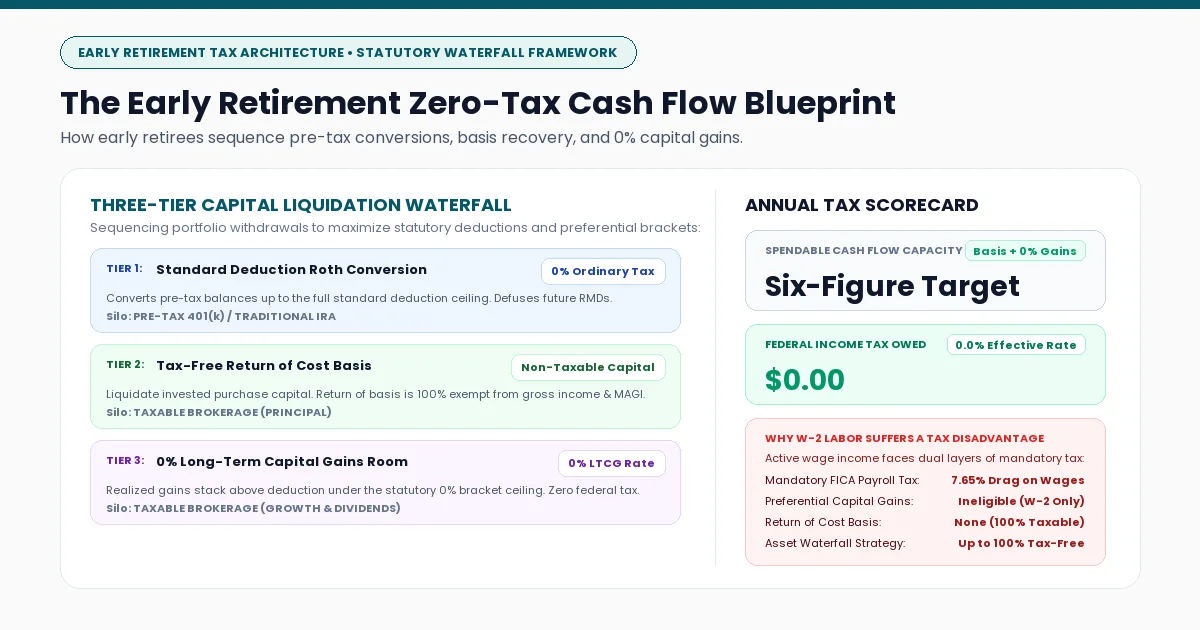
How Early Retirees Live on Six Figures Tax-Free with $0 in Federal Income Tax
Discover how early retirees engineer six-figure spendable cash flow while paying $0 in federal income tax using the strategic tax waterfall strategy.

Should You Turn On DRIP? The Pros, Cons, and Tax Traps for High Earners
Dividend reinvestment plans (DRIP) offer frictionless compounding, but can trigger tax traps in taxable accounts. Here is when to use DRIP and when to keep cash.
Discussion 🟢 Open for Discussion 0