How Early Retirees Live on Up to $128,900+ Cash with $0 in Federal Income Tax
To live on $128,900 of spendable cash with $0 in federal income tax, an early retiree structures their withdrawals across three specific buckets: $32,200 in pre-tax Roth conversions absorbed by the standard deduction, alongside up to $96,700 in realized Long-Term Capital GainsProfits earned from selling assets you owned for longer than one year, which are taxed at preferential rates (0%, 15%, or 20%) rather than standard paycheck income tax rates. and Qualified DividendsDividends paid by regular US corporations and qualifying foreign firms that are taxed at lower long-term capital gains rates (0%, 15%, or 20%) instead of higher ordinary income tax rates. taxed at the preferential 0% rate.
This strategy is not an aggressive loophole. It is an intentional alignment with how federal tax policy taxes invested capital differently than labor income. While a corporate W-2 wage earner must gross over $150,000 to net $128,900 after payroll taxes and federal brackets, an early retiree utilizing modern balance sheet architecture achieves a 0.0% effective federal tax rate on the exact same cash flow. Furthermore, when factoring in non-taxable return of purchase Cost BasisThe original money you paid for an investment plus reinvested dividends. When you sell, you are only taxed on your actual investment profits above this number, never on your original cash. from a taxable brokerage portfolio, total spendable cash flow can comfortably scale to $225,600 or more while maintaining a $0 federal tax obligation.
Understanding this architecture requires looking past gross balances and mastering simple portfolio sequencing: deduction timing, preferential gain stacking, and healthcare subsidy optimization.
The Structural Problem: Why W-2 Labor Taxes Are So Inefficient
The federal tax code penalizes labor income through two distinct layers: mandatory payroll taxes and ordinary income tax brackets.
When an employee earns a $128,900 salary, their top dollar does not just face marginal federal brackets. Every dollar up to the Social Security wage cap is hit with a mandatory 7.65% FICA drag (6.2% for Old-Age, Survivors, and Disability Insurance plus 1.45% for Medicare hospital insurance). For a married couple filing jointly where one or both spouses earn $128,900 in W-2 wages, mandatory FICA TaxesFederal payroll taxes consisting of Social Security (6.2%) and Medicare (1.45%) levied strictly on W-2 wage and active self-employment earnings, never on capital gains, dividends, or retirement distributions. wipe out $9,861 before income taxes are even calculated.
After applying the 2026 Married Filing Jointly (MFJ)A federal tax filing status for married couples that doubles standard deduction thresholds and income tax bracket widths compared to single filers. basic standard deduction of $32,200, the remaining $96,700 is taxed through ordinary brackets (10% and 12%). This generates another $11,127 in federal income tax, bringing total federal tax drag to $20,988 (an effective federal reduction of 16.3%).
In contrast, investment cash flows originate from balance sheet assets rather than active labor. Long-term capital gains and qualified dividends are completely exempt from FICA taxes. Furthermore, long-term capital gains and dividends benefit from preferential tax brackets that start at 0.0%.
W-2 Labor Tax Friction vs. Asset Cash Flow
6.2% Social Security + 1.45% Medicare applied to every dollar from gross payroll.
Taxed on $96,700 remaining after $32,200 MFJ standard deduction.
Investment liquidations, capital gains, and Roth conversions trigger zero payroll taxes.
Standard deduction wipes out Roth conversion; capital gains fill the 0.0% bracket.
The 3-Bucket Wealth Architecture
Executing a tax-free cash flow blueprint requires holding assets across three distinct balance sheet silos:
- The Taxable Brokerage Account (The Foundation Engine): Holds low-cost broad-market index funds (such as VOO or VTI, which you can evaluate using our VOO vs VTI ETF Overlap Tool). This account supplies both tax-free return of purchase principal (cost basis) and preferential 0% long-term capital gains and dividends.
- The Pre-Tax Retirement Account (The Deduction Engine): Holds Traditional 401(k) and Traditional IRA balances. This pool is tapped intentionally each year to absorb the standard deduction via a Roth Conversion Ladder, converting pre-tax dollars into tax-free Roth dollars without paying income tax.
- The Roth Account (The Tax-Exempt Overflow Buffer): Holds Roth IRA and Roth 401(k) balances accumulated during working years through direct contributions, employer match allocations, and the Mega Backdoor Roth. This bucket provides tax-exempt liquidity for unexpected lumpy expenses without affecting reported income.
The 2026 Tax Stacking Waterfall
Federal income taxes follow a strict stacking order. Ordinary income sits at the base of the tax stack and absorbs deductions first. Long-term capital gains and qualified dividends stack directly on top of ordinary income, occupying the higher layers of the calculation.
The $128,900 Tax-Free Cash Flow Waterfall
Here is how early retirees sequence their cash flow to capture the statutory maximum for the 2026 tax year (Married Filing Jointly):
Step 1: Standard Deduction Absorption ($32,200)
For the 2026 tax year, the basic standard deduction for Married Filing Jointly is $32,200 (which adjusts upward over time with inflation). If an early retiree has zero earned wage income, this $32,200 deduction sits completely empty.
Leaving the standard deduction unused is an expensive missed opportunity. Instead, the retiree executes a deliberate $32,200 Roth conversion from their Traditional IRA or 401(k) into their Roth IRA. While a Roth conversion counts as ordinary income on paper, the $32,200 standard deduction offsets it dollar-for-dollar:
Result: Exactly $0 in federal income tax owed on the conversion, shifting $32,200 permanently into a tax-free Roth account.
The retiree pays $0 in federal income tax on this conversion. Meanwhile, $32,200 moves permanently into a tax-exempt Roth account, satisfying the first leg of their 5-year conversion pipeline.
Step 2: Return of Invested Principal / Basis Recovery
To fund immediate living expenses, the retiree sells shares from their taxable brokerage account. When you sell shares in a taxable account, your proceeds consist of two parts: your original purchase money (cost basis) and your investment profit (capital gain).
For a portfolio that has grown over time, an investor might average a 50% cost basis ratio. Selling $193,400 worth of broad-market index fund shares returns $96,700 in original cost basis alongside $96,700 in investment gains. The return of principal is completely tax-free recovery of your own money. It does not count as taxable income, triggers zero taxes, and is excluded from healthcare subsidy calculations.
Step 3: Preferential 0% Long-Term Capital Gains Room ($96,700)
The remaining cash flow consists of investment earnings: realized long-term capital gains from share sales, plus qualified dividends generated by the broader taxable portfolio.
For 2026, the 0% long-term capital gains bracket ceiling for Married Filing Jointly is $96,700 of taxable income. Because Step 1 fully offset the Roth conversion against the standard deduction, taxable ordinary income sits at exactly $0.
The capital gains and dividends fill the preferential bracket starting from dollar zero, absorbing up to the full $96,700 statutory limit at a 0.0% tax rate:
Result: Zero federal tax drag on realized gains up to the statutory bracket ceiling.
Step 4: Spendable Cash Summary
The retiree combines the cash from these transactions:
- Tax-Free Basis Liquidation: Up to $96,700
- 0% Realized Capital Gains & Qualified Dividends: $96,700
- Tax-Free Standard Deduction Conversion or Cash Reserves: $32,200
Side-by-Side Comparison: W-2 Wage Earner vs. Asset Architecture
The mechanics table below highlights the structural advantage of capital architecture over active labor for funding a $128,900 lifestyle in 2026:
| Cash Flow & Tax Metric | W-2 Wage Earner (MFJ) | Asset Cash Flow Architecture | Difference |
|---|---|---|---|
| Gross Inflow / Cash Sourced | $128,900 (Salary) | $128,900 (Basis + Gains + Divs) | $0 |
| FICA Payroll Taxes (Social Security & Medicare) | -$9,861 (7.65%) | $0.00 (Exempt) | +$9,861 Saved |
| Tax-Free Return of Cost Basis | $0.00 | Non-Taxable Principal | 100% Exempt |
| Basic Standard Deduction (2026 MFJ) | -$32,200 | -$32,200 (Absorbs Roth Conversion) | Neutral |
| Taxable Ordinary Income | $96,700 | $0.00 | -$96,700 Taxable |
| Realized Preferential Gains & Dividends | $0.00 | $96,700 (Taxed at 0.0%) | $0 Federal Tax |
| Federal Income Tax Liability | -$11,127 | $0.00 (0.0% Effective) | +$11,127 Saved |
| Net Spendable Cash Remaining | $107,912 | $128,900 | +$20,988 (+19.4% Boost) |
Interactive Simulator: 2026 Early Retirement Tax Waterfall
Test your own portfolio withdrawal parameters. Adjust your annual target spend, average cost basis ratio, and planned Roth conversion to compute your realized capital gains, taxable income, and estimated federal tax obligation.
2026 Zero-Tax Waterfall Simulator
Reflects purchase principal vs. capital gains inside shares sold.
2026 MFJ Standard Deduction is $32,200.
Critical Strategic Nuances & Real-World Traps
Executing this strategy successfully requires active navigation around three major pitfalls:
1. Affordable Care Act (ACA) Silver Plan Subsidy Arbitrage
One of the largest hidden expenses in early retirement is unsubsidized health insurance. An unsubsidized health insurance policy for a couple in their 40s or 50s can easily cost $16,000 to $24,000 annually.
Health insurance premium tax credits under ACA (Affordable Care Act)The federal comprehensive healthcare law that provides health insurance exchanges, Premium Tax Credits, and Cost-Sharing Reductions based on household Modified Adjusted Gross Income (MAGI). are determined by your Modified Adjusted Gross Income (MAGI), not your gross cash expenditure. Because return of basis ($40,000 in our baseline scenario) is non-taxable recovery of capital, it is completely excluded from MAGI.
Note: Your $40,000 return of purchase cost basis is completely omitted from MAGI, keeping reported income low.
For early retirees seeking even greater healthcare savings, reducing the Roth conversion slightly during early retirement years can drop MAGI into the $40,000 to $60,000 range (between 200% and 300% of the Federal Poverty Level for a household of two). This unlocks Cost-Sharing Reduction (CSR)An Affordable Care Act provision that lowers out-of-pocket healthcare costs (deductibles, copayments, coinsurance) for households enrolled in Silver tier marketplace plans with income between 100% and 250% of the Federal Poverty Level., reducing maximum out-of-pocket deductibles from $9,000+ to under $1,500 while securing $12,000 to $18,000 in annual premium tax credits.
2. The State Income Tax Disconnect
A common mistake among early retirees is assuming state tax codes replicate federal rules. The 0% preferential long-term capital gains rate is strictly a federal provision.
States handle investment returns in vastly different ways:
- States with No Personal Income Tax: Texas, Florida, Nevada, Washington, Wyoming, South Dakota, Alaska, and Tennessee impose 0% state income tax. In these states, early retirees capture the full $0 tax benefit at both federal and state levels.
- States that Tax Capital Gains as Ordinary Income: California, New York, New Jersey, and Massachusetts offer zero preferential tax rates for long-term capital gains. In California, realized capital gains and Roth conversions face ordinary state tax rates starting at 1% and quickly climbing to 9.3% and beyond.
- Washington State's Capital Gains Tax: While Washington levies no income tax, it imposes a 7% tax on long-term capital gains exceeding $270,000. However, our six-figure cash flow blueprint remains far below this threshold.
3. The Pre-Tax RMD Time-Bomb
Some retirees attempt to maximize short-term simplicity by living exclusively on taxable brokerage cash and doing zero Roth conversions. While this achieves a $0 tax bill today, it creates a severe structural risk in later decades.
If a 45-year-old early retiree leaves a $1.5 million pre-tax 401(k) balance untouched to compound at 7% real returns, that balance will surpass $8 million by age 73. Under the SECURE 2.0 Act, mandatory Required Minimum Distributions (RMDs) begin at age 73 or 75. An $8 million balance triggers a mandatory Year 1 distribution exceeding $300,000, forcing the retiree into the highest federal tax brackets (37%) and triggering maximum Medicare .
Executing an annual Roth conversion up to the basic standard deduction ceiling defuses this time-bomb while your income is at its lifetime low.
4. Extending the Blueprint: Low-Bracket Roth Conversion Arbitrage (10% and 12%)
What if your household needs $150,000 in annual cash flow, or you hold a multimillion-dollar pre-tax balance that requires faster drawdown to curb future RMD (Required Minimum Distribution)Statutory minimum amounts that owners of pre-tax retirement plans (Traditional 401(k), Traditional IRA) must withdraw annually starting at age 73 or 75 under SECURE 2.0, triggering mandatory ordinary income taxes.? You do not have to halt conversions strictly at the standard deduction boundary.
By intentionally pushing into the 10% and 12% ordinary brackets, early retirees can execute substantial Roth conversions at negligible tax drag:
- The 10% Bracket Tier: For MFJ filers in 2026, the first $24,800 of ordinary income above the standard deduction is taxed at 10%. Converting an additional $24,800 costs just $2,480 in federal income tax (an effective tax rate of just 4.4% across your first $57,000 of converted pre-tax retirement money).
- The 12% Bracket Tier: Ordinary income between $24,800 and $100,800 is taxed at 12%. Converting an additional $40,000 in this band costs $4,800.
- Capital Gains Interaction: Because ordinary income stacks first, converting additional dollars absorbs taxable income room. Any taxable long-term capital gains that sit below the 0% capital gains ceiling ($96,700 in taxable income for MFJ) continue to enjoy a 0.0% federal rate. Only the portion pushed above that threshold pays 15%.
Paying a 5% to 8% effective tax rate in your 40s or 50s to insulate a large portfolio against 32% to 37% tax rates later in life represents one of the highest-leverage tax planning moves in early retirement. You can model this multi-year pipeline using our free Roth Conversion Ladder Calculator.
5. Specific Identification (SpecID) Accounting
Never liquidate shares in a taxable account using "Average Cost" accounting. Instruct your brokerage platform (such as Fidelity, Charles Schwab, or Vanguard) to designate Specific Identification (SpecID) as your default tax-lot disposal method.
SpecID lets you choose the exact shares you sell. By liquidating newer lots with high cost basis, you return more cash with less taxable gain, keeping your MAGI precisely dialed into your target ACA subsidy and 0% capital gains boundaries. For years with market downturns, combining SpecID with Tax-Loss Harvesting lets you offset up to $3,000 of ordinary income and create loss carryforwards to neutralize future gains.
Conclusion: Engineering Financial Independence on Your Own Terms
Generating $128,900 to $225,600 in spendable annual cash flow while legally paying $0 in federal income tax is not an exotic loophole or a high-risk accounting gimmick. It is the natural mathematical result of treating tax planning as an active portfolio discipline rather than an annual chore in April.
By coordinating your balance sheet across three distinct pools (taxable brokerage basis, standard deduction Roth conversions, and preferential 0% long-term capital gains), you transform how the tax code treats your wealth. You insulate your household from mandatory payroll taxes, safeguard valuable healthcare premium subsidies, and steadily convert pre-tax balances before mandatory RMDs kick in.
Real financial freedom is not just about accumulating a specific net worth number. It is about keeping what you have earned through disciplined drawdown sequencing, ensuring that every dollar on your balance sheet delivers maximum spendable freedom for decades to come.
Frequently Asked Questions
Quick answers to common questions, technical edge cases, and tax rules.
What are the exact income limits to pay 0% federal tax on capital gains in 2026?
For the 2026 tax year, the 0% long-term capital gains and qualified dividend bracket ceiling is $96,700 for Married Filing Jointly ($48,350 for Single filers). Because long-term capital gains stack on top of ordinary income after subtracting the standard deduction ($32,200 for MFJ in 2026), a married couple with zero wage income can absorb up to $128,900 in total gross taxable income completely tax-free.
Does generating $128,900 tax-free increase audit risk?
No. This cash flow architecture does not rely on aggressive shelters, offshore shell companies, or grey-area loopholes. It operates entirely within foundational tax rules: the basic standard deduction, non-taxable recovery of purchase cost basis, and preferential 0% long-term capital gains brackets. Brokerage 1099-B and 1099-DIV forms clearly report your cost basis and dividend classifications, reconciling automatically with tax reporting systems.
How do state income taxes treat the 0% federal capital gains rate?
Federal 0% preferential capital gains rates do not automatically carry over to state tax returns. States such as California and New York tax capital gains as ordinary income at rates exceeding 9% to 13.3%. In contrast, no-income-tax states like Texas, Florida, Washington, Nevada, and Tennessee allow early retirees to capture the full $0 tax benefit at both federal and state levels.
How does the $128,900 cash flow blueprint impact Affordable Care Act (ACA) healthcare subsidies?
Because return of cost basis does not count toward Modified Adjusted Gross Income (MAGI), a household spending $128,900 cash can report a MAGI aligned with statutory thresholds. In 2026, managing income unlocks Silver Tier Cost-Sharing Reductions (CSR) and Premium Tax Credits worth $10,000 to $20,000 annually.
Can I extend this tax waterfall into the 10% and 12% brackets if I spend more or have a large 401(k)?
Yes. Once you absorb the standard deduction ($32,200 for MFJ) at 0%, additional pre-tax Roth conversions are taxed at just 10% (up to $24,800 in taxable income) and 12% (up to $100,800). As long as total taxable income stays within the 0% long-term capital gains boundary, your capital gains remain untaxed, allowing early retirees to accelerate Roth conversions at a single-digit effective tax rate to prevent future RMD spikes.
Download the 0% Capital Gains Stacking Worksheet & Annual Tax-Waterfall Spreadsheet
A high-density reference breaking down the 2026 MFJ standard deduction absorption, cost basis recovery, and 0% LTCG ceilings.
- ✓ 2026 statutory bracket ceilings & standard deduction waterfall
- ✓ Side-by-side W-2 wage earner vs. asset cash flow mechanics table
- ✓ ACA Silver plan CSR subsidy and Lot ID accounting protocols
Your PDF is Ready!
Click below to download or save your printable companion guide:
We also sent a backup copy to your email. Keep this checklist handy for retirement and tax planning!
Scan to Open on Phone
Point your phone's camera at the QR code to seamlessly continue reading or calculate with your current inputs on mobile.
 Buck by Buck
No app required
Bookmark this page
Press ⌘+D or Ctrl+D to save to your browser bookmarks.
Your Next Step
Roth Conversion Ladder Calculator
Simulate annual pre-tax IRA conversions and 5-year penalty-free withdrawal pipelines.
Debt Avalanche vs. Investing Calculator
Stress-test risk-free debt paydown hurdles against after-tax equity market compounding.
Living Trust Brokerage Retitling Checklist
Protect your taxable brokerage assets and ensure seamless multi-generational wealth transfer.
Trending & Popular Guides
How to Set Up a Mega Backdoor Roth With Fidelity
How to Set Up a Backdoor Roth IRA With Fidelity
How to Set Up Automatic Investing with Fidelity
How to Set Up Automatic Investing with E*TRADE
Related Articles & Guides
View all guides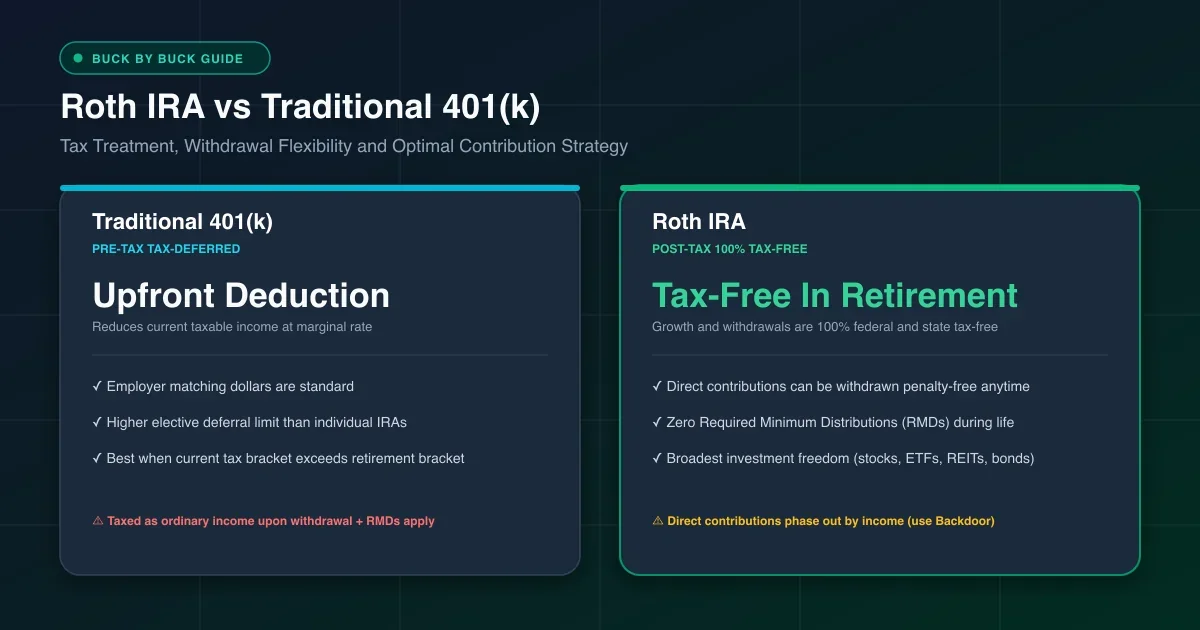
Roth IRA or 401(k): Which One Is Right For You?
I hear it all the time, “Should I invest in a Roth IRA or a 401(k)?” To help you answer that question, first we need to know what they are and what some of their benefits are. From

Should You Turn On DRIP? The Pros, Cons, and Tax Traps for High Earners
Dividend reinvestment plans (DRIP) offer frictionless compounding, but can trigger tax traps in taxable accounts. Here is when to use DRIP and when to keep cash.

What's A Mega Backdoor Roth?
If you like your Roth IRA for its tax-free growth, you’re really going to like a mega backdoor Roth! Contributions to a Roth IRA are funded with after-tax dollars and earnings grow
Discussion 0
Questions, thoughts, or experience to share on How Early Retirees Live on Up to $128,900+ Cash with $0 in Federal Income Tax? Join the conversation below.