
Roth Conversion Ladder: Step-by-Step Guide & 5-Year Rule Timeline
Listen to Full Article
ReadyFull article audio (18 min) • Click to listen from start to finish
Read Selection (0 words)
"..."
Ch: Roth Conversion Ladder: Step-by-Step Guide & 5-Year Rule Timeline
A Roth Conversion LadderA technique for early retirees to access Traditional 401(k) and IRA money before age 59½ without early penalties by converting chunks to a Roth IRA each year and waiting 5 years to withdraw each batch. lets you tap pre-tax 401(k) and Traditional IRA money before age 59½ without paying the 10% early withdrawal penalty by converting one year of spending from pre-tax to a Roth IRA every year and withdrawing each converted slice once its 5-year waiting clock clears.
This simple sequence solves the biggest fear people have about maxing out tax-deferred retirement accounts: "Why lock my savings away until I am almost 60 if I want to retire at 38, 45, or 52?" Instead of leaving pre-tax tax breaks on the table, you capture high-bracket tax deductions while working, then unlock that same money during lower-income retirement years at minimal or even zero federal tax.
In this step-by-step guide, you will learn exactly how the 5-year rule clock works, see a year-by-year timeline from Year 1 through Year 8, avoid the hidden withholding mistake that triggers an automatic 10% penalty, and balance conversions alongside ACA healthcare subsidies.
Why Early Retirees Use a Roth Conversion Ladder
During your peak earning years, contributing to a pre-tax 401(k) shields your top marginal dollars from 22%, 24%, 32%, or even 37% federal brackets plus state income taxes. The catch is that standard distributions taken directly from a Traditional 401(k) or Traditional IRA before age 59½ usually face ordinary income tax plus a steep 10% early withdrawal penalty.
A Roth conversion ladder turns that two-part tax hit into a controlled pipeline:
- Step A (Save High): Contribute pre-tax dollars while your salary is high, compounding those saved tax dollars inside your account.
- Step B (Convert Low): Once you stop working or drop into part-time consulting, move a manageable chunk of pre-tax money into a Roth IRA each calendar year. You owe ordinary income tax only on the slice you convert, not the whole account, and there is never a 10% early penalty on a Roth conversion itself.
- Step C (Season & Spend): Let each annual conversion sit for five full tax years. Starting in Year 6, that converted principal becomes 100% accessible tax-free and penalty-free at any age.
Want to test numbers for your own portfolio while reading? Open our interactive Roth Conversion Ladder Calculator in a second tab to model your balance across 2026 tax brackets and see exact unlock dates.
The Two 5-Year Rules (And Why Mixing Them Up Costs You)
Half the confusion around Roth ladders comes from combining two completely separate five-year clocks under tax law. Only one controls your converted principal before age 59½.
Applies individually to every taxable conversion you perform while under age 59½.
- Starts: January 1 of the tax year each conversion occurs.
- Ends: January 1 five years later (five full tax years).
- Unlocks: Tax-free, penalty-free access to that converted principal at any age.
- Exception: Vanishes permanently the day you turn 59½.
A one-time lifetime clock tied to the very first dollar you ever placed into any Roth IRA.
- Starts: January 1 of the year you first funded any Roth IRA.
- Ends: Never resets on later conversions or rollovers.
- Unlocks: Completely tax-free withdrawal of investment earnings once you reach age 59½.
- Note: Direct Roth contributions can always be withdrawn anytime regardless of this clock.
Notice the hidden superpower in how the calendar works: the conversion clock backdates to January 1 of the conversion year.
If you convert $40,000 on December 20, 2026, tax rules count all of 2026 as Year 1. Year 2 is 2027, Year 3 is 2028, Year 4 is 2029, and Year 5 is 2030. On January 1, 2031, just four years and twelve days after your actual trade settled, that $40,000 unlocks completely free of penalties.
Year-by-Year Roth Conversion Ladder Timeline (Worked Example)
To make the moving parts crystal clear, imagine a married couple retiring early on January 1 with $1,400,000 invested: $300,000 in a taxable brokerage and cash savings, $900,000 in a Traditional 401(k)/IRA, and $200,000 in a Roth IRA (half direct contributions, half growth).
Suppose their annual spending target is $64,000 per year. Here is what their conversion ladder looks like across Years 1 through 8, converting roughly $32,200 to $50,000 annually inside low federal brackets while living off their cash bridge during the 5-year warmup period:
How Annual Conversions Mature Into Penalty-Free Paychecks
| Ladder Year | Convert to Roth | Living Cash Source | Unlocked Rung Available | Est. Federal Tax on Conversion |
|---|---|---|---|---|
| Year 1 (Retire) | $50,000 (Rung 1) | Taxable Bridge / Cash | Rung 1 seasoning (Yr 1/5) | ~$1,780 (effective ~3.6%) |
| Year 2 | $50,000 (Rung 2) | Taxable Bridge / Cash | Rung 1 (2/5), Rung 2 (1/5) | ~$1,780 |
| Year 3 | $50,000 (Rung 3) | Taxable Bridge / Cash | Rung 1 (3/5) maturing | ~$1,780 |
| Year 4 | $50,000 (Rung 4) | Taxable / Direct Roth Basis | Rung 1 (4/5) maturing | ~$1,780 |
| Year 5 | $50,000 (Rung 5) | Taxable / Direct Roth Basis | Final bridge year | ~$1,780 |
| Year 6 (Unlock!) | $50,000 (Rung 6) | Rung 1 ($50k) + $14k Taxable | $50,000 Tax & Penalty Free | ~$1,780 on Rung 6 |
| Year 7 | $50,000 (Rung 7) | Rung 2 ($50k) + $14k Taxable | $50,000 Tax & Penalty Free | ~$1,780 on Rung 7 |
| Year 8+ | Ongoing Conversions | Rung 3 ($50k) + Cash / Gains | Self-sustaining paycheck | Optional $0 if converting $32,200 |
*Illustrative federal tax figures assume Married Filing Jointly (MFJ)A federal tax filing status for married couples that doubles standard deduction thresholds and income tax bracket widths compared to single filers. with $32,200 standard deduction and 2026 10% bracket scaling; converting strictly up to your standard deduction yields $0 federal tax.
Notice what happens if you stay strictly at or below your standard deduction ($32,200 MFJ or $16,100 Single in 2026) and supplement living cash with non-taxable return of Cost BasisThe original money you paid for an investment plus reinvested dividends. When you sell, you are only taxed on your actual investment profits above this number, never on your original cash. from a taxable brokerage account: your federal tax bill on both the conversion and the withdrawal drops all the way to $0.
How to Build and Execute a Roth Conversion Ladder (6 Steps)
Step 1: Calculate Your 5-Year Bridge Buffer
Before making your first conversion, audit where Years 1 through 5 of spending will come from while your initial tranche ages. Any of these penalty-free sources work as a bridge:
- Taxable brokerage account: Selling index fund lots yields original cost basis completely tax-free, plus Long-Term Capital GainsProfits earned from selling assets you owned for longer than one year, which are taxed at preferential rates (0%, 15%, or 20%) rather than standard paycheck income tax rates. taxed at 0% inside federal ceilings.
- High-yield cash, T-bills, or money market funds: Spending principal generates no new tax trigger beyond interest already earned.
- Prior direct Roth IRA contributions: Unlike conversions, the money you originally contributed directly to any Roth IRA can always be pulled out immediately at any age, tax-free and penalty-free.
- HSA medical receipts: Valid reimbursable HSA receipts saved during your career can be cashed out tax-free at any point.
- Part-time / "Coast" income: Even modest consulting revenue shrinks the amount of portfolio cash needed during Years 1 to 5 (though earned income absorbs part of your low tax bracket room).
Use our When Can I Retire Runway Simulator to verify whether your taxable and cash accounts can sustain five consecutive years of withdrawals without forcing premature retirement account distributions.
Step 2: Consolidate Pre-Tax Funds Into a Traditional IRA
Most workplace 401(k) plans do not let terminated employees execute arbitrary partial annual rollovers straight into an outside Roth IRA without complicated paperwork or administrative fees. Once you leave your employer, perform a direct trustee-to-trustee rollover of your Traditional 401(k) into a Traditional IRA at a low-fee brokerage like Fidelity, Charles Schwab, or Vanguard.
Crucial check for high earners still working: If you are planning a ladder years before leaving your job while also executing an annual Backdoor Roth IRA, do not hold pre-tax dollars inside a Traditional IRA on December 31. Doing so triggers the IRA aggregation (pro-rata) rule and turns your clean Backdoor Roth into a taxable mess. Keep pre-tax dollars inside your employer 401(k) until you actually stop making Backdoor Roth contributions.
Step 3: Pick Your Annual Conversion Sweet Spot
Each November or December, calculate the exact dollar amount to convert based on your other income for the calendar year. Early retirees usually target one of three mathematical zones:
- Zero-Tax Zone (Standard Deduction Ceiling): Convert up to your unused standard deduction (Standard Deduction minus Other Ordinary Income, equal to $32,200 for married joint filers or $16,100 for single filers in 2026). Your effective federal tax on the conversion is 0.0%.
- 10% and 12% Bracket Arbitrage Zone: If you hold a seven-figure Traditional balance that will trigger huge RMD (Required Minimum Distribution)Statutory minimum amounts that owners of pre-tax retirement plans (Traditional 401(k), Traditional IRA) must withdraw annually starting at age 73 or 75 under SECURE 2.0, triggering mandatory ordinary income taxes. in your 70s, converting up to the top of the 10% bracket ($24,800 taxable income for MFJ) or 12% bracket ($100,800 taxable income for MFJ) locks in a single-digit effective rate today and shrinks future tax bombs.
- ACA Healthcare Subsidy Ceiling: When buying health insurance on Healthcare.gov or your state exchange, your conversion directly raises your household MAGI (Modified Adjusted Gross Income)Your household income after adding back specific deductions. It determines eligibility for Roth IRA contributions, health insurance premium tax credits under the ACA, and other income-tested tax benefits.. Sometimes stopping a conversion $5,000 earlier saves $4,000 in marketplace health insurance premiums and deductibles.
Step 4: Execute Before December 31 With Zero Tax Withholding
To count toward the 2026 tax year, a Roth conversion must be completed inside your brokerage account by December 31. Do not wait until tax day in April; April deadlines apply to IRA contributions, never conversions.
Inside your custodian's online portal, select "Convert Traditional IRA to Roth IRA" and choose whether to transfer cash or transfer ETF/index fund shares in-kind (converting shares in-kind keeps you continuously invested in the market during the transfer!). When prompted for tax withholding:
- Always select 0% Federal and 0% State Withholding if you are under age 59½.
- Pay any resulting tax bill using cash from checking or taxable savings via estimated quarterly payments or April tax settlement.
Step 5: Track Each Rung and File Cleanly at Tax Time
In January following your conversion, your brokerage sends Form 1099-R (reporting the gross amount moved out of your Traditional IRA) and in May sends Form 5498 (confirming the amount deposited into your Roth IRA). You will report the taxable conversion on Form 8606 (Part II) with your tax return.
Maintain a simple 5-column spreadsheet tracking: Tax Year Converted, Dollar Amount Converted, Whether Tax Was Owed, Unlock Date (Jan 1 + 5 Years), and Amount Withdrawn So Far. If you ever withdraw converted money early before age 59½, that spreadsheet paired with archived Form 8606 filings proves to tax authorities that each dollar satisfied its 5-year clock.
Step 6: Withdraw Unlocked Principal Starting Year 6
On January 1 of your sixth ladder year, Rung 1 officially matures. When you transfer that amount out of your Roth IRA into checking, your brokerage issues another Form 1099-R coded as an early distribution because you are under age 59½. Simply complete Form 8606 (Part III) on your tax return to show your cumulative prior conversion basis covers the withdrawal, bringing both federal income tax and early penalties to $0.
How Roth IRA Ordering Rules Actually Work
Investors often worry: "Wait, what if my Year 1 $50,000 conversion grows to $75,000 over five years? How do I avoid accidentally withdrawing the $25,000 of investment gains?"
Good news: you do not have to segregate investments or open multiple Roth IRAs for each year's rung. Across all Roth IRAs combined, tax rules enforce strict withdrawal ordering every time you take money out:
Always come out first, 100% tax-free and penalty-free at any age with zero waiting period.
Taxable conversions (like pre-tax ladder rungs) come out before non-taxable basis conversions from the same year. Each year clears its own 5-year clock.
Never touched until every dollar of contributions and conversion principal is gone. Keep untouched until age 59½ (and 5 years from your very first Roth IRA).
Because gains always come out dead last, your growth compounds safely inside the Roth wrapper while you peel off original direct contributions and 5-year-seasoned converted principal from the top.
Balancing Conversions Against ACA Subsidies and 0% Capital Gains
When you model a multi-year ladder, two extra variables sit right next to your tax bracket: 0% long-term capital gains space and healthcare marketplace subsidies.
Remember how federal tax brackets stack: ordinary income (including every dollar of your Traditional-to-Roth conversion) fills the bottom of your income stack first, and long-term capital gains sit on top of that stack. For 2026, a married couple filing jointly pays 0% federal tax on capital gains as long as taxable income stays below $96,700 ($48,350 for single filers).
At the same time, Roth conversions increase your MAGI dollar-for-dollar, whereas returning original cost basis from a taxable brokerage account adds zero to MAGI. By combining modest Roth conversions with high-basis taxable brokerage sales, many early retirees capture six figures of spendable cash while keeping reported MAGI inside sweet spots for ACA (Affordable Care Act)The federal comprehensive healthcare law that provides health insurance exchanges, Premium Tax Credits, and Cost-Sharing Reductions based on household Modified Adjusted Gross Income (MAGI). subsidies. Explore the exact dollar math in our companion Zero-Tax Early Retirement Blueprint.
Roth Conversion Ladder vs. Rule of 55 vs. 72(t) SEPP
The Roth conversion ladder is usually the most flexible way to unlock pre-tax retirement accounts early, though two sibling rules also bypass the 10% early penalty in specific situations:
| Feature | Roth Conversion Ladder | Rule of 55 | 72(t) SEPP |
|---|---|---|---|
| Minimum Age | Any age | Leave employer in year turning 55+ | Any age |
| Waiting Period | 5 tax years per rung | Immediate upon separation | Immediate |
| Annual Flexibility | High (adjust or pause any year) | Moderate (depends on plan rules) | Rigid (locked 5 yrs or age 59½) |
| Penalty If Stopped Early | None (you can stop anytime) | None | Retroactive 10% penalty + interest |
| Eligible Accounts | Traditional IRAs & old 401(k)s | Current employer 401(k) only | IRAs & non-active 401(k)s |
Want to compare how Rule of 55 and 72(t) distributions work alongside a Roth ladder? Check out our walkthrough on 3 Little-Known Ways to Access Your 401(k) Penalty-Free Before 59½.
5 Costly Mistakes to Avoid on Your Roth Conversion Ladder
- Withholding conversion taxes inside the transfer (under 59½): Always elect 0% withholding and pay taxes from outside cash. If you convert $40,000 and let the brokerage send $4,800 directly to the IRS, only $35,200 enters your Roth IRA, and that $4,800 gets hit with a 10% early withdrawal penalty ($480 wasted).
- Starting five years too late without a cash bridge: If you retire with 100% of your net worth in a 401(k) and zero taxable brokerage or Roth basis, a Roth ladder alone leaves you stranded for Years 1 to 5 unless you bridge the gap using a 72(t) SEPP plan on a slice of your IRA.
- Converting while still earning peak salary: Executing large pre-tax-to-Roth conversions during a high-W-2 year piles conversion dollars onto your 24%, 32%, or 35% marginal tax bracket. Wait until the first January 1 after leaving high-income work whenever possible.
- Forgetting state income taxes: High-tax states like California, New York, and New Jersey tax Roth conversions just like ordinary wages, whereas states like Florida, Texas, Washington, Nevada, and Tennessee impose 0% state tax on conversions. Factor state savings into relocation math with our State Tax Exodus Simulator.
- Mixing up non-deductible IRA basis (the pro-rata trap): If you have mixed deductible and non-deductible dollars across Traditional IRAs, every partial conversion draws proportionally from both pools. Clean up or roll pre-tax Traditional IRA dollars into a workplace 401(k) before doing annual Backdoor Roth steps.
Next Step: Map Out Your Custom Conversion Ladder
Building a Roth conversion ladder takes about 15 minutes of clicking inside your brokerage once a year, yet it routinely saves six figures in lifetime federal taxes while unlocking early retirement decades before age 59½.
Run your real numbers today using our Roth Conversion Ladder & Tax Bracket Optimizer, verify your 5-year bridge runway in the When Can I Retire Calculator, and see how conversions fit inside a complete $0-tax spending plan in our Zero-Tax Early Retirement Blueprint.
Scan to Open on Phone
Point your phone's camera at the QR code to seamlessly continue reading or calculate with your current inputs on mobile.
 Buck by Buck
No app required
Bookmark this page
Press ⌘+D or Ctrl+D to save to your browser bookmarks.
Frequently Asked Questions
Quick answers to common questions, technical edge cases, and tax rules.
How does a Roth conversion ladder work in simple terms?
A Roth conversion ladder works by moving a portion of your pre-tax Traditional IRA or 401(k) into a Roth IRA each year, paying ordinary income tax on that conversion, waiting five full tax years, and then withdrawing the converted principal completely tax-free and penalty-free before age 59½. While the first five conversion rungs are maturing, you live off savings, taxable brokerage accounts, or direct Roth contributions.
When does the 5-year clock start for a Roth conversion?
The 5-year waiting period starts on January 1 of the calendar year in which you execute the conversion, regardless of whether you convert in January or December. For example, a conversion completed on December 15, 2026 is treated as starting January 1, 2026, making that converted principal eligible for penalty-free withdrawal on January 1, 2031.
What is the deadline to complete a Roth conversion for the current tax year?
A Roth conversion must settle by December 31 to count for that calendar tax year, unlike regular IRA contributions which allow until the April 15 tax filing deadline. Because brokerages experience heavy volume in late December, most early retirees initiate conversions by mid-December so the custodian settles the transfer before year-end.
Do I pay tax on the gains inside my converted Roth ladder money when I withdraw it?
No, as long as you only withdraw your original converted principal before age 59½. Roth IRA withdrawal ordering rules treat direct contributions as coming out first, followed by converted principal on a first-in, first-out basis, and investment earnings last. You must leave investment growth untouched until age 59½ (and after your first Roth IRA has been open 5 years) to avoid taxes and penalties on gains.
Should I have my brokerage withhold taxes when doing a Roth conversion?
No, if you are under age 59½ you should elect 0% tax withholding on the conversion and pay any owed tax from a separate checking or brokerage account. Any conversion dollars withheld by the brokerage and sent directly to the IRS never reach your Roth IRA, so tax rules treat that withheld portion as an early withdrawal hit with a 10% penalty.
How much should I convert each year on a Roth conversion ladder?
Most early retirees convert at least enough to absorb their standard deduction ($16,100 Single or $32,200 Married Filing Jointly in 2026), which results in $0 federal income tax on the conversion. Higher-balance savers often convert further through the 10% or 12% federal brackets while keeping total Modified Adjusted Gross Income inside target Affordable Care Act health insurance subsidy thresholds.
Download the Early Retirement Tax-Waterfall & Conversion Stacking Worksheet
A printable quick-reference worksheet mapping standard deduction absorption, conversion brackets, 5-year seasoning timelines, and ACA subsidy thresholds.
- ✓ Standard deduction and 10%/12% conversion bracket targets
- ✓ 5-year conversion seasoning schedule and bridge planning notes
- ✓ MAGI guardrails for ACA healthcare premium tax credits
Your PDF is Ready!
Click below to download or save your printable companion guide:
We also sent a backup copy to your email. Keep this checklist handy for retirement and tax planning!
Your Next Step & Related Guides
View all resources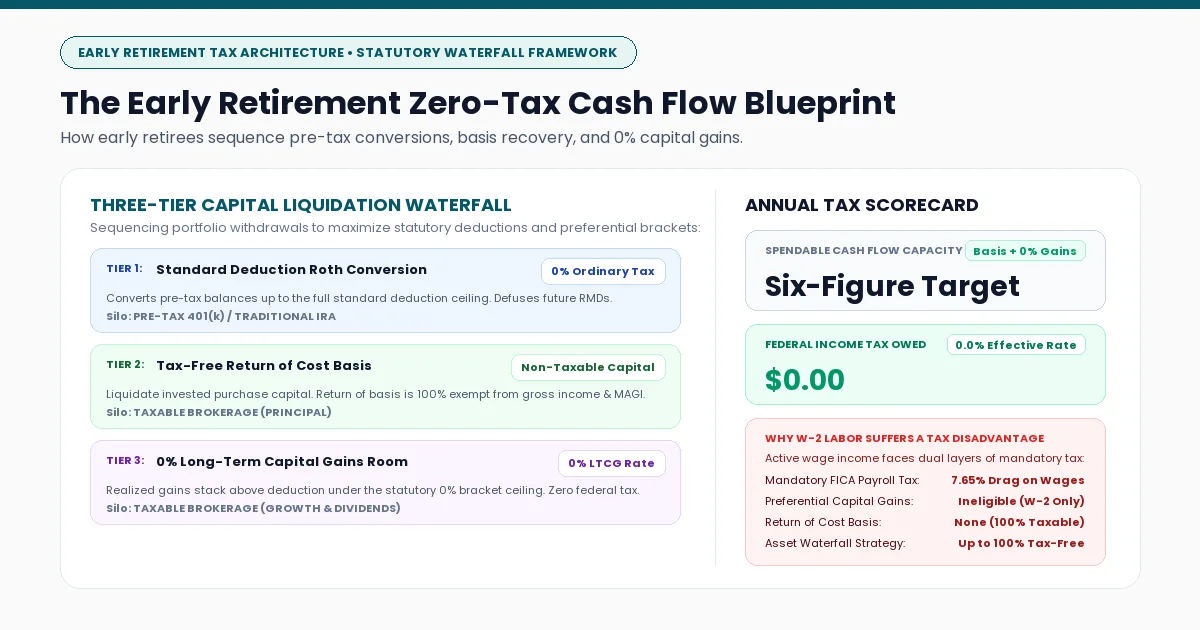
Roth Conversion Ladder Calculator
Plug in your Traditional balance and watch each conversion tranche unlock year by year.
How Early Retirees Live on Six Figures Tax-Free with $0 in Federal Income Tax
Discover how early retirees engineer six-figure spendable cash flow while paying $0 in federal income tax using the strategic tax waterfall strategy.

3 Little-Known Ways To Access Your 401(k) Penalty-Free Before 59 ½
If you’re part of the FI/RE community and are thinking about retiring early like I am, you might be wondering why you should contribute to your 401(k) if you won’t be able to acces
Discussion 0
Author replies within 24h