
Should You Pay Off Debt or Invest Surplus Cash Flow?
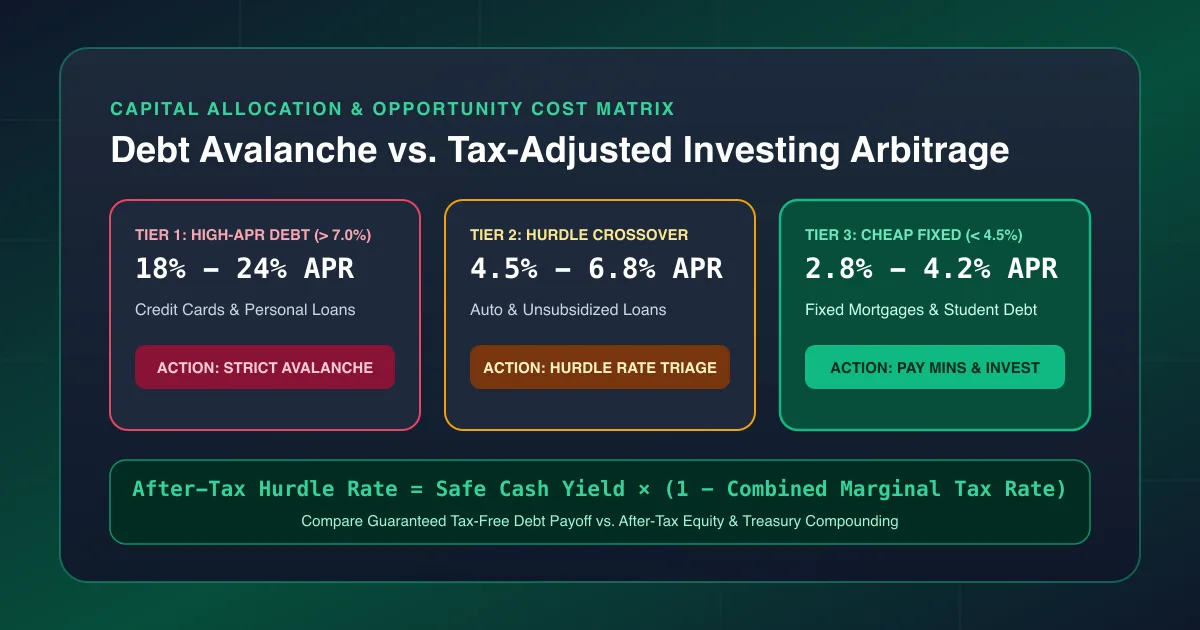
To maximize net worth, compare each loan's Annual Percentage Rate (APR) against your after-tax hurdle rate. Paying off non-deductible consumer debt delivers a guaranteed, risk-free, tax-free return equal to the loan's APR. Therefore, you should aggressively pay down any debt carrying an interest rate above 6.5% to 7.0% before investing in taxable equities (outside of capturing an employer 401(k) match). Conversely, if a debt's APR is lower than your after-tax safe cash yield or long-term expected equity return (such as a 3.0% to 4.5% mortgage or student loan), pay only the scheduled monthly minimum and deploy surplus cash flow into low-cost index funds.
The Exact Mathematical Formula: After-Tax Hurdle Rates Explained
Most generic debt payoff calculators commit a fundamental accounting error: they compare a pre-tax investment return directly against a debt's nominal interest rate. In the real world, taxes create an asymmetric wedge between interest you earn and interest you save.
When you pay down $1,000 of principal on a 6.0% auto loan, you avoid $60 in annual interest charges. The Internal Revenue Service does not tax avoided interest. A 6.0% debt paydown is functionally identical to earning a 6.0% guaranteed, after-tax return.
By contrast, when you deposit $1,000 into a High-Yield Savings Account (HYSA), money market fund, or Treasury bill yielding 4.5%, that interest is taxed at your ordinary federal and state marginal income tax rate. To compare saving cash against paying down debt on an apples-to-apples basis, you must calculate your After-Tax Cash Hurdle Rate:
Example: At a 4.50% HYSA rate and a 32% combined federal + state marginal tax bracket (24% Federal + 8% State), your true after-tax yield is 4.50% × (1 - 0.32) = 3.06%.
This formula exposes why millions of high-income households accidentally lose money while attempting "cash arbitrage." If you hold extra cash in a 4.50% savings account while carrying a 4.00% student loan or auto loan, you might believe you are earning a +0.50% positive spread. Once you account for a 32% marginal tax drag, your savings account only nets 3.06%, meaning you are paying a -0.94% negative spread every year for the privilege of holding that debt.
Extending the Formula to Taxable Stock Market Investing
When the alternative to debt payoff is investing in a diversified equity index fund (such as VOO or VTI) rather than sitting in cash, two variables change:
- Preferential Capital Gains & Dividend Tax Treatment: Unlike savings account interest taxed at ordinary income brackets (up to 37% federal), long-term capital gains and qualified dividends in a taxable brokerage account are taxed at 15% or 20% (plus the 3.8% Net Investment Income Tax for high earners). Furthermore, unrealized capital appreciation compounds tax-deferred until you sell shares.
- The Equity Risk Premium (Volatility Adjustment): Paying off a 7.0% debt is 100% certain. Earning 8.0% to 10.0% in the S&P 500 carries sequence-of-returns volatility. Financial economists apply a 1.0% to 1.5% risk-aversion haircut when comparing volatile equity returns against risk-free debt elimination.
Example: Assuming an 8.0% nominal index return and a 15% effective long-term capital gains and dividend drag, your net compounding rate is 8.0% × (1 - 0.15) = 6.80%.
Consequently, any debt with an APR above 6.80% should be treated as an immediate priority for accelerated payoff, while liabilities below that threshold allow your surplus dollars to compound faster inside an investment portfolio. If you invest inside tax-advantaged accounts (like a Mega Backdoor Roth 401(k) or Backdoor Roth IRA), your investment growth is 100% tax-free, raising your effective hurdle rate to the full 8.0% nominal return.
The Psychological Cost of the Snowball Method
Popularized by radio hosts and behavioral finance authors, the Debt Snowball Method instructs borrowers to list all liabilities from smallest dollar balance to largest dollar balance, completely ignoring the interest rate on each loan. All extra cash is thrown at the smallest balance until it disappears, creating a rapid dopamine hit ("quick win") that motivates the borrower to stay on budget.
While behavioral adherence matters for households struggling with basic impulse control, the Debt Snowball imposes a steep, quantifiable mathematical tax on disciplined investors. When you prioritize a $4,000 student loan at 4.2% APR ahead of a $16,000 credit card at 22.9% APR, you allow an 18.7% annual interest differential to compound against your balance sheet.
Even worse, both the strict Snowball and strict Avalanche methods share a second flaw: they demand 100% debt eradication before investing a single dollar, even when your remaining debts carry ultra-low 3.0% to 4.5% fixed interest rates. Deciding to throw $1,500 a month of extra principal at a 3.25% mortgage instead of buying index funds forfeits decades of compound market growth.
Empirical Comparison: Snowball vs. Avalanche vs. Tax-Adjusted Arbitrage
Consider a typical dual-income household carrying four liabilities totaling $329,000 ($8,500 credit card at 21.9%, $22,000 auto loan at 6.5%, $18,500 student loan at 4.2%, and a $280,000 mortgage at 3.1%) with $1,500 per month in surplus cash flow and an 8.0% expected market return:
| Strategy Metric | Method 1: Strict Snowball | Method 2: Strict Avalanche | Method 3: Tax-Adjusted Arbitrage |
|---|---|---|---|
| Primary Allocation Rule | Smallest balance first ($8.5k → $18.5k → $22k → $280k) | Highest APR first (21.9% → 6.5% → 4.2% → 3.1%) | Kill >6.8% APR debt first; pay minimums on low-rate debt & invest surplus |
| Toxic 21.9% Credit Card Eliminated | Month 6 | Month 6 | Month 6 |
| Month Investing Begins | Delayed until all debt = $0 (10+ yrs) | Delayed until all debt = $0 (10+ yrs) | Month 6 (Immediately after card payoff) |
| Liquidity & Emergency Resilience | Low (Cash locked inside illiquid home/loan equity) | Low (Cash locked inside illiquid home/loan equity) | High (Surplus compounds in liquid brokerage shares) |
| 10-Year Net Worth Impact | Lowest (High interest + missed market compounding) | Moderate (Saves loan interest, forfeits equity spread) | Highest (Captures +3% to +4% positive arbitrage spread) |
The 3-Tier Interest Rate Triage Framework
To execute Tax-Adjusted Arbitrage without second-guessing your monthly cash flow, categorize every liability on your balance sheet into one of three distinct APR zones:
Tier 1: Toxic High-Interest Debt (> 7.0% APR) → Emergency Avalanche
Credit cards (18% to 29% APR), unsecured personal loans (10% to 16%), and subprime auto loans destroy wealth faster than any asset class can build it. No stock market index fund can reliably deliver a 22% after-tax guaranteed return.
- Action Plan: Halt all taxable brokerage investing temporarily (only contribute enough to your 401(k) to capture a 50% or 100% employer match, which is an instant 50% to 100% return). Throw every dollar of monthly surplus at the highest-APR Tier 1 debt using the strict Avalanche sequence.
- Refinancing Lever: If you hold substantial taxable index funds, you can also evaluate replacing a 22% credit card balance with a low-rate Securities-Backed Line of Credit (SBLOC) or European Box Spread at 4.3% to 5.2% while you pay it down, cutting your interest bleed by 75%.
Tier 2: The Grey Zone (4.5% to 7.0% APR) → Tax-Bracket & Risk-Tolerance Dependent
Modern auto loans, unsubsidized graduate student loans, and recent 2023 to 2026 residential mortgages typically sit between 5.0% and 6.8% APR. Here, the spread between paying off debt and investing in stocks is narrow.
- Action Plan: First, max out tax-advantaged retirement space (Traditional/Roth 401(k), HSA, and Backdoor Roth IRA), because the upfront tax deduction or tax-free compounding easily beats a 5.5% debt cost.
- The 50/50 Split Rule: Once tax-sheltered accounts are full, if a loan sits around 6.0% APR and you are torn between guaranteed debt reduction and taxable brokerage investing, split your monthly surplus 50/50. Sending $750/mo to extra loan principal and $750/mo to automated index fund purchases captures half the guaranteed interest savings while keeping your dollar-cost averaging engine running.
Tier 3: Cheap Fixed-Rate Debt (< 4.5% APR) → Never Prepay, Always Arbitrage
Legacy fixed-rate mortgages (2.5% to 4.0%), subsidized federal student loans, and promotional 0% APR financing are financial assets in disguise. Because inflation averages 2.5% to 3.0% over time, you are repaying the lender with progressively cheaper future dollars while your own capital earns 8.0% to 10.0% in equities, or even 4.5%+ in risk-free Treasury bills.
- Action Plan: Put these loans on auto-pay for the exact minimum monthly payment required and never send an extra dime of principal.
- Liquidity Bonus: When you prepay $50,000 onto a 3.2% mortgage, that $50,000 is trapped inside your home's drywall. If you lose your job or face an emergency, the bank will not let you skip next month's mortgage payment just because you prepaid principal last year. By investing that $50,000 in a liquid brokerage account instead, you earn a higher return and retain 100% access to your capital at any time.
How Tax-Deductible Debt Changes the Arbitrage Equation
Not all debt is paid with after-tax dollars. If a liability qualifies for a federal and state tax deduction, its Effective After-Tax APR is lower than the stated rate on your monthly statement:
- Mortgage Interest Deduction (Schedule A): If you itemize deductions above the standard deduction threshold, mortgage interest on up to $750,000 of qualified acquisition debt reduces your taxable income. A 6.50% mortgage for a household itemizing in the 35% combined tax bracket carries an effective after-tax cost of
6.50% × (1 - 0.35) = 4.23%. - Student Loan Interest Deduction: Below modified adjusted gross income (MAGI) phase-out limits, up to $2,500 of student loan interest is deductible "above the line" even if you take the standard deduction.
- Investment & Rental Property Interest (Schedule E / Form 4952): Interest on rental property mortgages or margin loans traced to taxable investments (under IRS Section 163(d)) directly offsets rental or investment income. Read more in our Bad Debt vs. Better Debt Analysis and test rental numbers in our Real Estate Evaluation Tool.
 Buck by Buck
Discussion 0
Questions, thoughts, or experience to share on Debt Avalanche vs. Investing Calculator? Join the conversation below.